
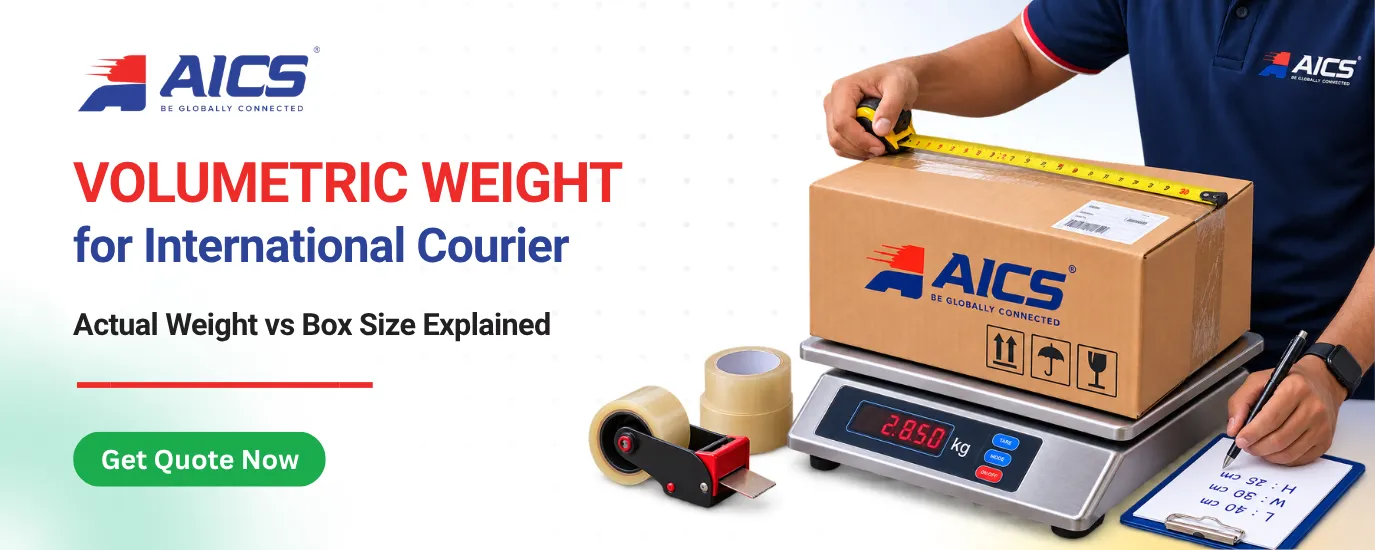
Introduction
Volumetric weight for international courier is a space-based weight calculation that can affect the chargeable weight of a packed parcel. A parcel may weigh 5 kg on a scale but have a higher volumetric weight because its carton occupies more transport space. Understanding this before you book a shipment can help you measure correctly, choose more appropriate packaging and request a more useful quote from international courier services from India.
This is especially important for lightweight but bulky shipments such as garments, gifts, household goods, handicrafts, samples, student belongings and e-commerce parcels. The final packed dimensions can make a significant difference to the weight used for courier billing.
Quick Answer
AICS states that volumetric weight is calculated as Length × Width × Height in centimetres ÷ 5,000. Compare the result with the parcel’s actual packed weight; the selected courier or service rules determine the applicable chargeable weight. Always measure the final sealed parcel, not the unpacked product.
What Is Volumetric Weight?
Volumetric weight, also called dimensional weight or DIM weight, converts the physical size of a parcel into a weight value. It exists because transport capacity is limited not only by how much weight an aircraft or delivery network can carry, but also by how much space each parcel occupies.
Think of two cartons travelling on the same route. One is compact and heavy. The other is light but much larger. The larger carton may occupy considerably more cargo space even though the scale shows fewer kilograms. Volumetric weight is a way to reflect that space usage in the shipment calculation.
Actual Weight vs Volumetric Weight vs Chargeable Weight
| Term | What it means |
|---|---|
| Actual Weight | The physical weight of the final packed parcel measured on a scale. |
| Volumetric Weight | A dimensional weight calculated using the parcel’s external length, width and height. |
| Chargeable / Billable Weight | The weight used to calculate the shipment rate under the applicable courier or service rules. |
For parcel services that use a higher-of-two method, a lightweight but oversized carton can therefore be billed based on its dimensional weight instead of its actual scale weight.
The exact billing method can depend on the selected courier service and applicable conditions.
Volumetric Weight for International Courier: How Is It Calculated?
The volumetric weight formula for courier is:
Volumetric Weight (kg)
Length × Width × Height in centimetres ÷ 5,000
AICS publishes this formula in its Conditions of Carriage.
UPS India and FedEx India also publish a 5,000 divisor for dimensional-weight calculations on relevant parcel services. UPS India Dimensional Weight Guidance FedEx India Dimensional Weight Calculation
However, service-specific rules can differ. Do not assume that the same divisor, rounding method or billing rule applies to every courier, freight mode, account or contract.
Example 1: When Actual Weight Is Higher
Suppose the final sealed carton measures:
40 × 30 × 20 cm
Calculation:
40 × 30 × 20 = 24,000 cm³
24,000 ÷ 5,000 = 4.8 kg volumetric weight
If the packed parcel actually weighs 7 kg, the actual weight is higher than the volumetric weight.
Under a higher-of-the-two billing method, the 7 kg figure would be the starting point for the billable-weight calculation, subject to the applicable service’s rounding and billing rules.
Example 2: When Box Size Pushes the Weight Up
Now consider a larger carton measuring:
60 × 40 × 30 cm
Calculation:
60 × 40 × 30 = 72,000 cm³
72,000 ÷ 5,000 = 14.4 kg volumetric weight
If the same carton weighs only 8 kg on the scale, the dimensional result is much higher.
The goods may be light, but the parcel occupies significantly more transport space.
This explains why a customer may say:
“My items are only 8 kg.”
while receiving a quote based on a higher chargeable weight.
How to Measure Your Courier Box Correctly
When preparing an international courier shipment, measure the final packed parcel, not the product before packing.
Follow these steps:
- Finish packing and seal the carton.
- Place the parcel on a flat surface.
- Measure the longest side as the length.
- Measure the remaining width and height at their outermost points.
- Weigh the complete packed carton.
- Record the dimensions and actual weight.
- Use these final details when requesting your courier quote.
UPS advises measuring a parcel at its extreme points and treating irregular packages as if they were enclosed in a rectangular box for dimensional measurement. UPS Shipping Dimensions and Weight
The practical lesson is simple:
Measure the outside of the finished shipment.
Why Oversized Packaging Can Increase International Courier Cost
A common packing habit is to select a large carton first and then fill unused space with paper, air pillows or other cushioning.
Protective material can be necessary, but excessive empty space can increase the parcel’s volumetric weight.
The goal is not to use the smallest box possible.
The better rule is:
Use the smallest suitable carton that protects the shipment properly and meets applicable product, courier and regulatory packing requirements.
1. Choose the Carton After Arranging the Products
Arrange the items and required protective material first.
Then select the closest suitable carton rather than automatically choosing a large box.
2. Remove Unnecessary Retail Packaging When Permitted
Retail or display packaging can sometimes take up significant space.
For eligible goods, consider whether unnecessary outer packaging can be removed without compromising product safety, documentation or destination requirements.
3. Consolidate Intelligently
Combining several parcels can sometimes reduce handling, but one oversized carton is not automatically cheaper.
Always compare the final dimensions before consolidating shipments.
4. Measure Only After Final Packing
Measurements taken before cushioning, double-boxing and sealing may not represent the final shipment.
Always calculate using the finished packed parcel.
5. Share Dimensions Before Pickup
For a more useful preliminary quote, provide:
- Destination country
- Destination city/postal code
- Item description
- Number of cartons
- Actual packed weight
- Final length
- Final width
- Final height
This gives the courier team better information to assess the likely chargeable weight.
Can Better Packing Actually Reduce Volumetric Weight?
Yes — when the original carton contains avoidable empty space and the goods can be safely repacked.
For example:
Oversized carton
60 × 40 × 30 cm
60 × 40 × 30 ÷ 5,000 = 14.4 kg
Better-sized carton
50 × 35 × 25 cm
50 × 35 × 25 ÷ 5,000 = 8.75 kg
The product, destination and actual weight may remain unchanged.
Only the packed volume has changed.
This example shows why carton selection matters when calculating volumetric weight for international courier shipments.
However, a lower dimensional weight does not automatically guarantee a specific reduction in the final courier price. Destination, service type, surcharges, shipment category and other pricing conditions can also affect the final charge.
When Should You Not Reduce the Box Size?
Never sacrifice shipment safety simply to reduce dimensional weight.
Fragile products may require:
- Corner protection
- Internal separation
- Sufficient cushioning
- Strong cartons
- Double-boxing
- Special handling
Dangerous goods and regulated commodities can also have specific packing and marking requirements.
AICS Conditions of Carriage covers packaging, export controls, dangerous goods and prohibited or restricted shipments. Review the applicable requirements before reducing packaging simply to lower the parcel volume. AICS Conditions of Carriage
What Else Affects an International Courier Quote?
Volumetric weight is only one part of international courier pricing.
AICS states that international courier charges can depend on factors including:
- Destination country
- Shipment weight — actual or volumetric
- Service type
- Nature of the goods
Other carrier or service conditions may also apply.
For broader pricing information, see the AICS guide to international courier charges from India.
That is why:
“How much does it cost to send 10 kg to the USA?”
may not provide enough information for an accurate quote.
A more useful enquiry would be:
“One packed carton to the USA, 10 kg actual weight, 48 × 38 × 32 cm, containing permitted garments, delivery postcode XXXXX.”
Providing the dimensions along with actual weight gives the courier team better information for reviewing the shipment.
Before You Request an AICS Courier Quote
Before requesting an international courier quote, keep the following information ready:
Destination : Country, city and postal code.
Contents : Clear description of the items inside the parcel.
Shipment Purpose : Personal, gift, sample or commercial.
Actual Weight : Weight of the final packed carton.
Dimensions : Final Length × Width × Height.
Number of Cartons : Total number of packages in the shipment.
Special Categories
Mention if the shipment contains categories such as medicine, food, fragile goods or dangerous goods.
For commercial or export shipments, you can also explore AICS export shipment services.
Frequently Asked Questions (FAQs)
Volumetric weight is a space-based weight calculated from the external dimensions of a packed parcel. It is used because a large lightweight parcel can occupy more transport capacity than a compact parcel of similar actual weight.
For services using a 5,000 divisor:
Length × Width × Height in centimetres ÷ 5,000
UPS India and FedEx India currently publish this calculation in their dimensional-weight guidance. Always confirm the rule for the service you are actually booking.
It depends on the service rules. A common approach is to compare actual and dimensional weight and use the higher as billable weight. UPS India explicitly describes this method for its parcel services.
Measure the final packed parcel, including its outer packaging.
Your parcel may have a higher dimensional weight because its carton occupies relatively more space. Other service-specific minimums or rules may also apply.
It can reduce dimensional weight when unnecessary empty space is removed, but packaging must still adequately protect the shipment.
Do not assume so. Carrier, service, freight mode, contract and destination rules can differ. Confirm the divisor used for your selected shipment before treating any calculation as final.
Final Takeaway
When planning an international courier from India, weigh the parcel — but measure it too.
The number on the scale tells only part of the story.
Correct final dimensions help you understand the likely chargeable weight, request a more useful quote and identify avoidable oversized packaging before your shipment is booked.
If the gap between actual and volumetric weight looks unusually large, review the packaging before assuming the courier rate itself is the only issue.
For a quote, provide AICS with your destination, item details, actual packed weight and final parcel dimensions.
Ready to Ship?
Send your packed box dimensions, actual weight, destination and item details to AICS for shipment guidance before booking.