
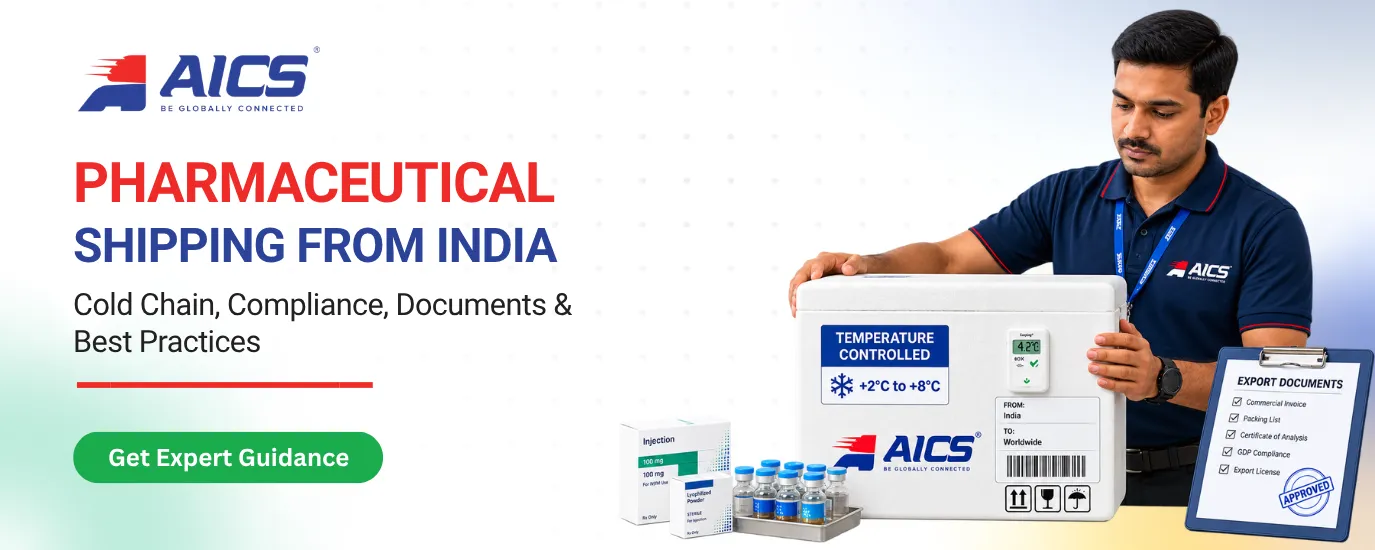
Introduction
Pharmaceutical shipping from India is not the same as sending a normal parcel internationally. A shipment may look perfectly fine from the outside and still become unsuitable if it is exposed to the wrong temperature, delayed without adequate protection, declared incorrectly at customs, or packed without considering the product’s approved storage requirements.
Pharmaceutical shipping therefore requires coordinated logistics, product protection, documentation and compliance planning. For Indian manufacturers, healthcare suppliers and exporters, the key question is not only speed, but whether the product can reach its destination within the required condition and compliance framework.
WHO guidance treats storage and distribution as important parts of the medical-product supply chain and notes that medical products can face risks during storage, repackaging, transportation and distribution.
Quick Answer: What Is Pharmaceutical Shipping?
Pharmaceutical shipping is the controlled transport of medicines, healthcare products and related goods while protecting quality, integrity, traceability and required storage conditions. Depending on the product, this may involve standard protected transport, refrigerated or frozen handling, insulated packaging, monitoring devices, additional customs documents or specialist air-freight support.
Why Pharmaceutical Products Need Special Logistics
Pharmaceutical products may require more than damage-free delivery. Exposure outside approved storage conditions can create a quality concern even when the outer package looks intact.
WHO and EMA GDP guidance emphasize protecting medicine quality, storage conditions and traceability throughout transport and distribution.
That changes the logistics questions. For pharmaceutical shipping, you may need to consider:
- What storage condition does the manufacturer specify?
- How long is the complete lane, including customs and airport dwell time?
- Does the product need insulated or validated packaging?
- Should a temperature logger or other monitoring device be used?
- What supporting documents and destination-country approvals apply?
- Can the chosen courier or air-freight service support the shipment profile?
Does Every Pharmaceutical Shipment Need Cold Chain?
No. “Pharmaceutical shipping” and “cold-chain shipping” are not automatically the same thing.
Different pharmaceutical products may require different storage conditions. Some products may be suitable for controlled room temperature; others may require refrigeration, freezing, deep-frozen handling or another product-specific condition. The correct requirement must come from the product/manufacturer storage specification and applicable regulations – not from a generic courier rule.
Important Publishing Rule :
Do not write “all pharmaceutical shipments must stay between 2°C and 8°C.” A safer and more accurate statement is: “Some temperature-sensitive pharmaceutical products require refrigerated handling such as 2°C-8°C, while other products may have different approved storage conditions.”
What Is Pharmaceutical Cold Chain?
A pharmaceutical cold chain keeps temperature-sensitive healthcare products within required conditions during storage, handling and transport.
It may combine thermal packaging, coolant systems, controlled transport, monitoring, route planning and documented handling.
IATA’s Temperature Control Regulations provide industry requirements and standards for the air transportation and handling of temperature-sensitive pharmaceutical products, including time- and temperature-sensitive labeling.
Not every pharmaceutical shipment needs refrigeration. The required condition must come from the product’s approved storage specification and applicable rules; 2°C-8°C is relevant to some products, not a universal pharma-shipping range.
Proper temperature control is an important consideration in pharmaceutical shipping from India, particularly for products that require specific storage conditions during transit.
AICS already covers personal-use medicine courier requirements separately in its personal medicine courier from India guide, while this article focuses on commercial and sensitive pharmaceutical logistics.
Packaging & Monitoring for Temperature-Sensitive Pharma
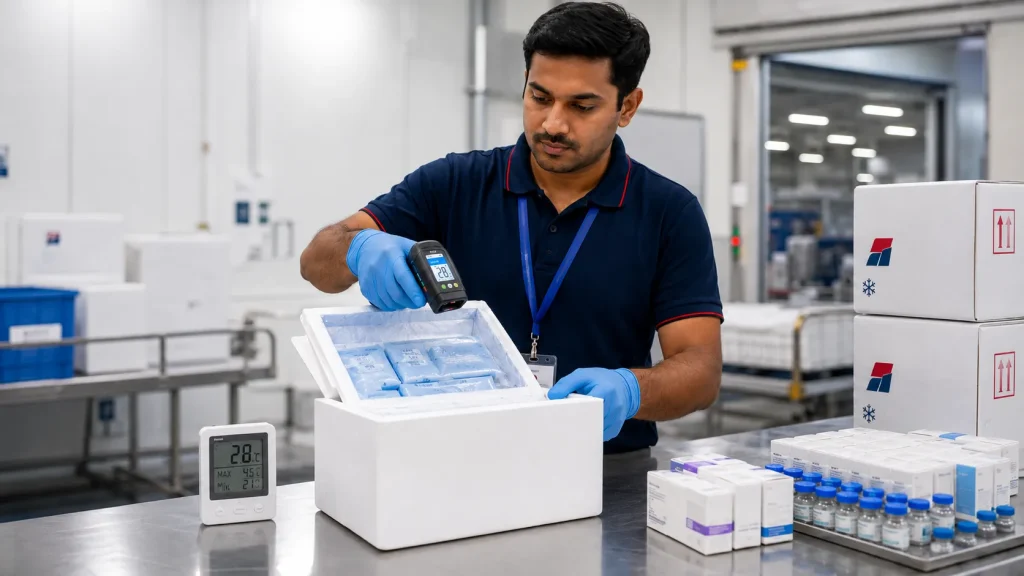
A box looking “insulated” does not prove that it can protect a pharmaceutical product for the entire lane. The packaging strategy should account for expected transit time, airport dwell time, seasonal temperatures, destination climate, customs-delay risk, product requirements and coolant duration.
Depending on the shipment, the solution may use passive insulated packaging with qualified coolant materials or a specialized active temperature-controlled system. Selection should match the product, route, duration and service capability.
IATA guidance emphasizes checking packaging requirements, carrier regulations and government requirements before shipping temperature-sensitive healthcare products.
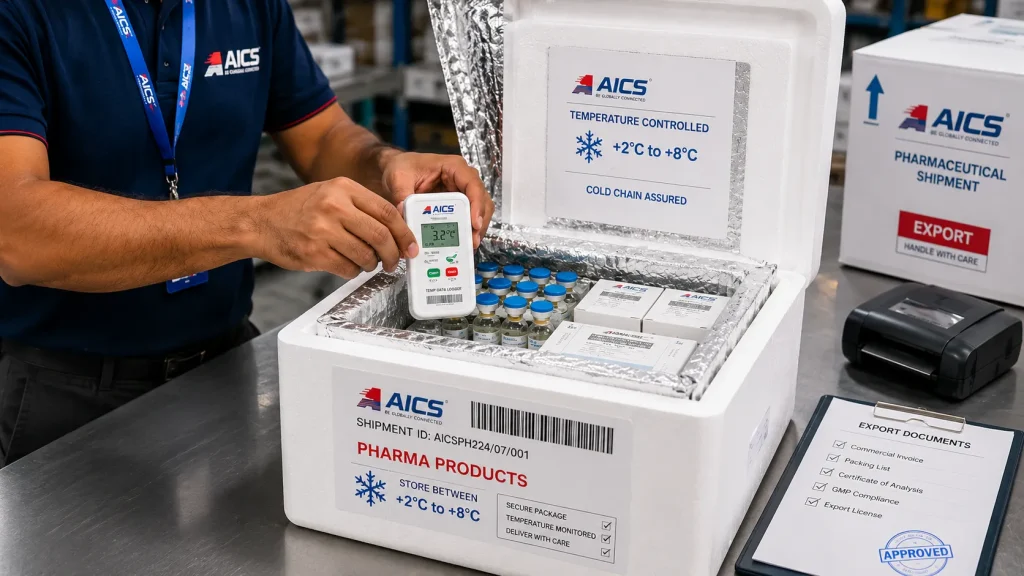
For critical shipments, monitoring can record conditions such as temperature, time, location, humidity or shock during transit.
A logger records or communicates data; it does not cool the shipment. Its data can support investigation if an excursion occurs.
Pharmaceutical Shipping Documents from India
| Document | Typical Purpose / Use |
|---|---|
| Commercial Invoice | Declares transaction, product, quantity and value information. |
| Packing List | Shows carton-wise contents, quantities, dimensions and packing details. |
| Air Waybill / Shipping Record | Identifies the transport movement and shipment details. |
| IEC / Exporter Details | Commercial export identity where applicable. |
| KYC / Authorization | Shipper verification and courier/export processing where applicable. |
| Product Information | Clear product description, composition/specification or classification where relevant. |
| Certificate of Analysis | May be requested by buyer, regulator or quality process for particular shipments. |
| Regulatory Approval / Licence | Only where required for the specific product, export purpose or destination. |
| Temperature Instruction / Handling Note | Supports temperature-sensitive shipment handling where required. |
| Destination-Specific Documents | Any additional import permit, declaration or support required by the receiving country. |
Before booking a shipment, review the documents required for international courier based on your shipment type.
Indian & Destination-Country Compliance
In India, drugs are regulated under the Drugs and Cosmetics Act, 1940 and the Drugs Rules, 1945, with CDSCO performing national regulatory functions in relevant areas. CDSCO states that bulk drugs and finished formulations fall within India’s drug regulatory framework and that registration or licensing requirements depend on the activity and product.
Requirements still vary by product, regulatory status, shipment purpose and destination; the same approval does not apply to every export.
Courier-mode customs processing uses the ECCS and applicable Courier Imports and Exports rules. Check regulatory feasibility before packing, not after pickup.
Indian export eligibility does not guarantee destination acceptance. Importing countries may impose separate rules for registration, importer authorisation, quantity, formulation, controlled substances, labelling, temperature records or certificates.
AICS should therefore maintain a pre-booking review approach rather than promise universal pharma acceptance.
For additional guidance on courier customs procedures, see the AICS guide to international courier customs clearance.
Step-by-Step Pharmaceutical Shipping Process from India
- Identify the exact product: Share the actual product name and category; avoid vague descriptions such as only “medicine” or “sample.”
- Confirm shipment purpose: Personal use, commercial sale, sample, B2B distribution, clinical/research or other.
- Confirm storage conditions: Follow approved product requirements for ambient, controlled, refrigerated, frozen or other handling.
- Check destination eligibility: Verify legal and operational acceptance before specialized packing.
- Prepare documentation: Invoice, packing list, shipper/receiver details and product-specific support documents as applicable.
- Select packaging: Match it to required condition, transit time, quantity, fragility and route risk.
- Add monitoring where needed: Use suitable temperature or condition monitoring for critical shipments.
- Choose courier or air freight: Base the mode on size, urgency, handling needs, route and availability.
- Customs clearance: Respond quickly to customs or document requests.
- Delivery and records: Retain shipment and monitoring records where required.
Courier vs Air Freight for Pharmaceutical Shipping
| When International Courier May Fit | When Air Freight May Fit |
|---|---|
| Small or moderate shipment size | Larger commercial or palletized shipment |
| Urgent shipment with compatible courier service | More complex routing or cargo handling requirement |
| Product accepted under express/courier rules | High-value or highly time-sensitive cargo |
| Documentation is ready and destination is serviceable | Temperature-sensitive cargo requiring more specialized handling |
| Samples, healthcare products or eligible commercial medicine shipments | Commercial pharma, medical supplies or sensitive products needing dedicated air-cargo support |
Pre-Shipment Pharmaceutical Checklist
- Confirm the exact product and formulation/category.
- Confirm destination country and postcode.
- Confirm shipment purpose: personal, sample, commercial or other.
- Confirm approved storage / handling condition.
- Check product and destination eligibility before packing.
- Prepare accurate invoice, packing list and supporting documents.
- Select suitable packaging and monitoring.
- Confirm courier or air-freight service availability.
- Keep the receiver available for destination clearance requests.
- Maintain shipment and monitoring records where required.
Before booking pharmaceutical shipping from India, confirm the product requirements, packaging, temperature conditions, destination and required documents.
Frequently Asked Questions (FAQs)
Yes, many pharmaceutical and healthcare products can be shipped internationally from India, but acceptance depends on product type, shipment purpose, destination-country regulations, documentation, carrier requirements and any applicable approvals. Review the shipment before packing.
No. Different products have different approved storage conditions. Some may move at controlled room temperature, while others require refrigeration, freezing or another specified condition.
Cold-chain pharmaceutical shipping is the controlled storage and transport of temperature-sensitive products using suitable packaging, handling, monitoring and transport processes.
Requirements vary, but commercial shipments commonly involve a commercial invoice, packing list, airway bill or shipping record, exporter/shipper information and product-specific or destination-specific supporting documents where applicable.
Yes. Pharmaceutical products can face customs or regulatory review where documents, product eligibility, value, licensing or destination requirements need clarification.
Conclusion
Pharmaceutical shipping from India is a coordinated product-condition, packaging, documentation, customs and route-management process.
The workflow should start with the product’s actual requirements, not a standard courier template.
Before pickup, confirm five things: eligibility, required condition, documents, packaging/transport mode and destination acceptance.
Once those answers are clear, the logistics plan becomes more predictable. AICS can support shipment review, export-documentation guidance, customs-aware coordination and suitable courier or air-freight routing, subject to product eligibility, carrier acceptance and applicable regulations.