Introduction
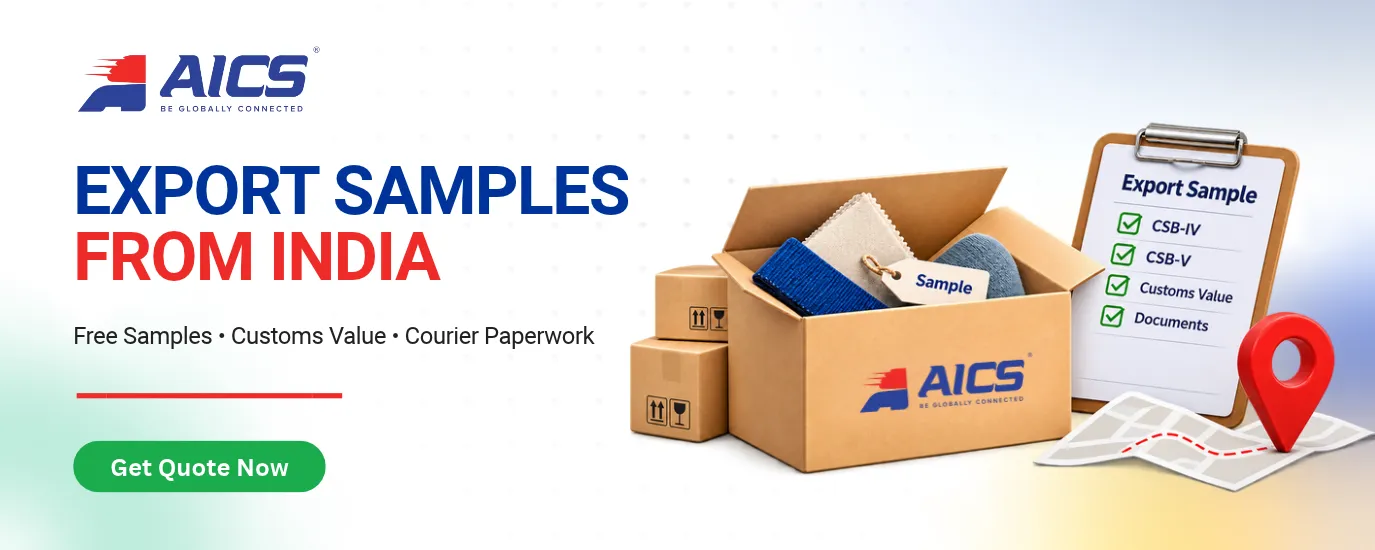
A textile manufacturer in Surat receives an enquiry from a buyer in Dubai. Before placing a bulk order, the buyer wants to check the fabric quality and requests a few samples.
The manufacturer agrees to send them free of charge. But before arranging the international courier, an important question arises: If the buyer is not paying for the samples, what value should be declared for customs?
This is a common situation for Indian exporters, manufacturers and B2B sellers. Whether you are sending fabric swatches, packaging materials or engineering components, free samples still require proper shipping documentation.
Understanding customs value, export declarations and the difference between CSB-IV and CSB-V can help you avoid unnecessary complications.
Can You Send Free Samples Abroad from India?
Yes. Indian businesses can send genuine trade and technical samples abroad, provided the products are eligible for export and comply with applicable customs, courier and destination-country requirements.
India’s Foreign Trade Policy permits bona fide trade and technical samples of freely exportable goods, subject to the relevant procedures.
However, free of charge does not mean zero customs value or automatic exemption from import duty.
Before shipping, confirm that the product is exportable, prepare accurate invoice details, identify the shipment purpose and check the applicable declaration with your authorised courier.
Free Sample vs Paid Trial Order vs Returnable Prototype
Before arranging an international sample courier, determine what type of shipment you are sending.
Genuine Free Trade Samples
A manufacturer sends a small quantity of products to an overseas buyer for evaluation without expecting payment.
For example, a Surat textile exporter sends five fabric swatches to a potential UK buyer to assess the fabric quality.
The invoice should accurately describe the samples, their purpose and a supportable customs value.
Paid Trial Orders
A buyer purchases a small quantity to test the product before placing a larger order.
Although the shipment may be called a sample order, it involves payment and is therefore a commercial transaction.
The exporter should inform the courier about the payment arrangement so the appropriate export declaration can be determined.
Returnable Prototypes
An engineering manufacturer sends a prototype overseas for testing, with an agreement that the same item will return to India.
Such shipments may require additional documentation, including serial numbers, return arrangements and the applicable temporary export and re-import procedure.
CSB-IV vs CSB-V: Which Courier Shipping Bill Applies?
When goods leave India through an authorised international courier, the applicable Courier Shipping Bill depends on the nature of the export.
Two important declarations are Courier Shipping Bill-IV (CSB-IV) and Courier Shipping Bill-V (CSB-V).
Understanding their purpose helps exporters communicate the correct shipment details to their courier service provider.
| Shipment Scenario | Transaction Details | Declaration to Verify |
|---|---|---|
| Free fabric samples | Genuine samples; no buyer payment | CSB-IV eligibility |
| Paid trial products | Goods supplied against payment | CSB-V or applicable commercial route |
| Returnable prototype | Item temporarily exported for evaluation | Relevant temporary export/re-import procedure |
What Is CSB-IV?
CSB-IV is associated with eligible bona fide gifts, trade samples and prototypes under India’s courier export framework.
For example, when a textile exporter sends fabric swatches to a potential buyer without charging for them, the courier may need to examine whether the shipment qualifies under CSB-IV.
The exporter should provide accurate information about the product, purpose and value.
The final classification must be confirmed by the authorised courier based on the current rules and shipment details.
What Is CSB-V?
CSB-V is associated with commercial exports involving foreign exchange.
If an overseas buyer purchases a small trial quantity from an Indian manufacturer, that shipment generally falls within the commercial export framework.
The exporter should provide the relevant commercial invoice and payment-related information.
The authorised courier will determine the applicable filing route.
Can You Declare Zero Customs Value for Free Samples?
No-charge goods can still have an economic value.
For example, an Indian manufacturer sends three sample fasteners to a prospective customer in Germany. The buyer pays nothing, but the products still have a material value.
The shipping paperwork may state:
“Samples Supplied Free of Charge – Value Declared for Customs Purposes Only.”
This wording should be used only when it accurately reflects the transaction and is accepted under the applicable documentation requirements.
The declared value must be reasonable and supportable.
Avoid entering zero or an artificially low amount simply because the buyer is not paying. Incorrect valuation can lead to customs queries, delays or additional checks.
Documents Required to Send Free Samples Abroad from India
Although documentation requirements vary by product, exporter and destination, preparing the essential details before pickup can make the shipping process more straightforward.
1. Sender and Consignee Details
Keep the Indian exporter’s legal name, pickup address and working contact information ready.
You will also need the overseas recipient’s full name, delivery address, postal code, phone number and email address.
Incorrect or incomplete consignee details can create avoidable delivery and clearance problems.
2. Detailed Product Description
Customs documentation should describe the actual goods rather than using broad terms such as “samples”, “material” or “parts”.
For example:
“Five cotton fabric swatches for quality and colour evaluation”
This is more informative than simply writing “textile samples”.
Where relevant, include:
- Product name and intended use.
- Material or composition.
- Model number or SKU.
- Quantity.
- Country of origin.
- Relevant classification details.
3. Pro Forma Invoice or Commercial Invoice
The courier may ask for a pro forma invoice, commercial invoice or another suitable declaration.
The appropriate document depends on the transaction and carrier requirements.
Where applicable, it should identify the exporter, consignee, goods, quantities, currency, declared value and purpose of shipment.
For genuine no-charge samples, the paperwork should reflect that no payment is expected while still providing an appropriate customs value.
4. Packing List
A packing list helps identify what is inside the parcel.
It may include the quantity of each product, number of packages, weight and dimensions.
The package details should match the other shipment documents.
5. Exporter KYC and Business Documentation
Exporters may be asked to provide KYC information, business identification, an Importer Exporter Code (IEC) or other documents depending on the export route and applicable rules.
A free sample should not automatically be assumed to qualify for an exemption from business documentation.
6. Product-Specific Permissions or Certificates
Certain products may require additional documentation even when supplied as samples.
Examples include regulated chemicals, medicines, food products and specific electronics.
The destination country may also impose restrictions.
Check the exact commodity before booking rather than assuming that all product samples can travel through ordinary courier channels.
7. Supporting Buyer Communication
Keep an email or other written communication explaining why the samples are being sent.
For a prototype that will return to India, retain the agreed return arrangements and relevant product identification details.
These records can help explain the purpose of the shipment if clarification is needed.
What Changed for Courier Exports in India in 2026?
India introduced an important courier-export reform effective 1 April 2026.
Under DGFT Notification No. 67/2025-26 and CBIC Circular No. 17/2026, the former ₹10 lakh per-consignment courier-export value ceiling was removed.
This reform provides greater flexibility for eligible exporters using international courier services.
However, removing the value ceiling does not eliminate export restrictions, product-specific requirements or customs documentation.
It also does not change the distinction between genuine free samples and paid commercial orders.
For more information, read AICS’s guide on courier exports from India and the 2026 value-limit removal.
What About FEMA and Bank Reporting?
Foreign-exchange reporting is another important consideration.
The RBI’s revised export and import regulations came into effect on 1 October 2026, with subsequent amendments.
Exporters should not assume that older exemptions for free-of-charge shipments automatically remain applicable.
Before sending no-payment commercial samples, consult your authorised dealer (AD) bank about the relevant declaration and reporting requirements.
Will the Overseas Buyer Pay Customs Duty on Free Samples?
Possibly.
A free sample exported from India is not automatically exempt from import duties in the destination country.
Depending on the product and country, the recipient may need to pay customs duty, VAT, GST or clearance charges.
Additional requirements may apply to regulated products.
Before dispatch, confirm the destination country’s import rules and clarify who will be responsible for any charges.
Common Mistakes to Avoid When Shipping Export Samples
Small documentation errors can create problems even for lightweight sample parcels.
Avoid these common mistakes:
- Describing a business sample as a personal gift.
- Declaring zero value without a valid basis.
- Treating a paid trial order as a free sample.
- Using vague descriptions such as “parts” or “goods”.
- Failing to disclose that a prototype will return to India.
- Assuming samples are automatically duty-free.
- Relying on outdated courier-export rules.
Accurate documentation before pickup is usually easier than correcting shipment information after a customs query.
Example: Sending Fabric Samples from Surat to the UK
Consider a Surat textile manufacturer sending five fabric swatches to a potential wholesale buyer in London.
The buyer wants to check the material before discussing a bulk purchase and is not paying for the samples.
Before booking the courier, the manufacturer should:
Confirm that the fabric is eligible for export.
Record the composition and quantity.
Prepare a truthful customs value and invoice.
Ask the courier whether CSB-IV is applicable.
Check the relevant UK import requirements.
Confirm any no-payment export reporting obligations with the AD bank.
Once the shipment requirements are clear, the manufacturer can proceed with booking.
The same approach is useful for eligible packaging samples, apparel materials, industrial components and other products sent for overseas evaluation.
How AICS Helps Indian Exporters Send Samples Abroad
For manufacturers and B2B suppliers, sending samples overseas is often the first step towards securing an international order.
Arihant International Courier Services (AICS) supports businesses shipping international parcels from India, including commercial products and eligible sample shipments.
AICS provides international courier coordination, pickup assistance, packaging support, shipment tracking and guidance on required shipping documentation.
Before requesting a quote, share:
- Destination country and postal code.
- Product description and quantity.
- Whether the buyer is paying.
- Customs value and shipment purpose.
- Packed weight and dimensions.
AICS can review the shipment details and available international courier options. Final acceptance and documentation requirements depend on the commodity, courier partner and destination.
Explore our international courier services or contact AICS to discuss your shipment.
Frequently Asked Questions (FAQs)
Yes. Eligible bona fide trade samples can be exported without charging the buyer, subject to applicable customs, courier and destination requirements.
Not automatically. CSB-IV is associated with eligible bona fide samples, but the authorised courier must confirm the correct declaration.
Do not assume zero value is acceptable. Free samples may still need a supportable customs value even when no payment is involved.
Documentation requirements depend on the exporter, goods and filing route. Confirm IEC requirements and any applicable exemptions before shipping.
Not necessarily. The destination country may impose customs duties, taxes or other import requirements.
Yes. AICS can review your product details, destination, parcel weight and shipping requirements to provide available courier options and a quotation.
Do not assume so. Carrier, service, freight mode, contract and destination rules can differ. Confirm the divisor used for your selected shipment before treating any calculation as final.
Final Thoughts
Sending free samples abroad can help Indian manufacturers and exporters introduce their products to international buyers.
However, a free sample is still an international shipment that requires accurate customs information.
Before dispatch, identify whether the goods are genuine samples, paid trial products or returnable prototypes. Prepare the correct description, value and supporting documents, and confirm the applicable courier and banking requirements.
Taking these steps early can help make international sample shipping more straightforward.
Planning to Send Product Samples Abroad?
Whether you are shipping fabric swatches, packaging samples or eligible manufactured products, AICS can help you explore suitable international courier options.
Get a Sample Courier Quote & Document Review
Call: +91 94260 52754
Website: www.aics.in
Regulatory note: This guide reflects information reviewed in November 2026. Export procedures, customs requirements and banking regulations may change. Confirm shipment-specific requirements with your authorised courier, AD bank or qualified compliance adviser before dispatch.