Introduction
UK customs charges on parcels from India often raise a question that the shipping quote alone cannot answer: will the recipient have to pay anything before receiving the parcel?
The answer depends on what you are sending, its declared value, whether it is a genuine gift or a purchase, and where in the UK it is going.
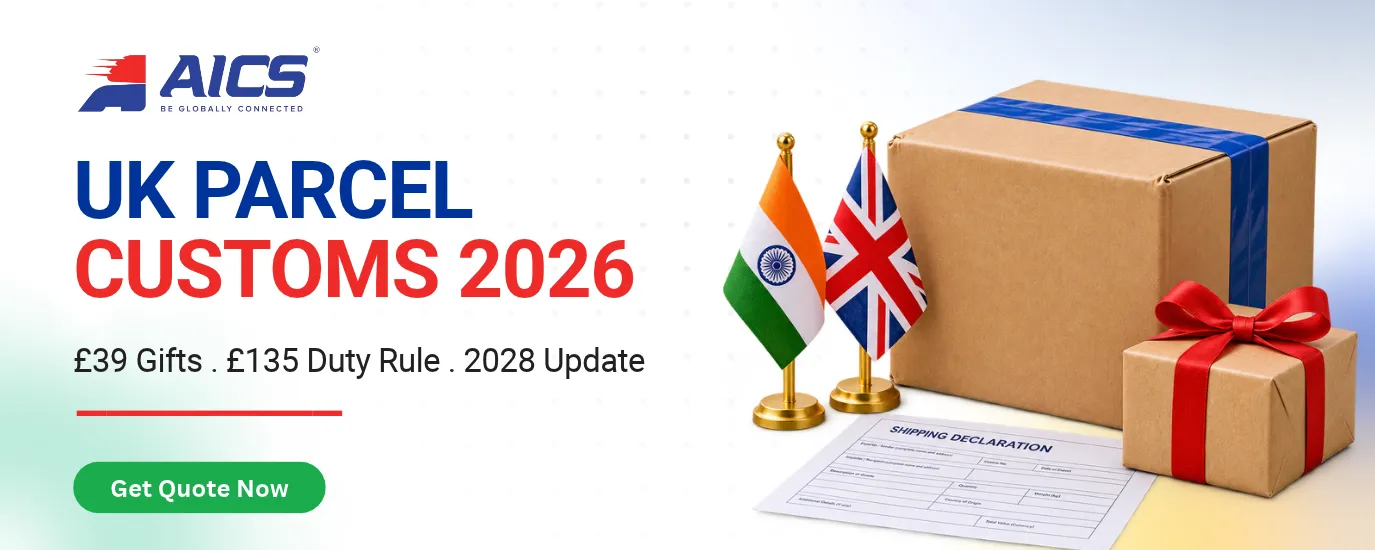
A birthday present from family, an online order and a commercial sample may arrive in similar boxes, but their customs treatment can differ. Two figures cause particular confusion: £39 and £135. The £39 rule concerns import VAT relief for qualifying private gifts, while the £135 threshold concerns Customs Duty relief for qualifying low-value goods. They should not be treated as one general “tax-free parcel allowance.”
There is also a future change to understand. The UK government has announced reforms to low-value imports, with implementation planned by October 2028 at the latest. As of November 2026, that announcement does not mean the existing £135 Customs Duty relief has already ended.
This guide explains what Indian families, online sellers and businesses should check before sending a parcel to the UK—from gift eligibility and potential recipient charges to the differences between Great Britain and Northern Ireland.
Will a UK Recipient Pay Customs Charges on a Parcel from India?
Possibly. In Great Britain, qualifying private gifts worth £39 or less generally receive import VAT relief. Qualifying non-excise goods worth £135 or less currently receive Customs Duty relief, but VAT may still apply. Purchased goods can have VAT collected at checkout. Courier charges may also be payable. GOV.UK
Before estimating costs, identify the shipment correctly:
- Is it an occasional gift between private individuals?
- Is it an item purchased from a seller?
- Is it a business order or commercial sample?
- Is the destination in Great Britain or Northern Ireland?
These details are more useful than simply asking whether “UK parcels are tax-free.”
What Counts as a Genuine Gift for UK Customs?
A parcel does not qualify as a gift just because “gift” is written on the declaration.
HMRC requires a qualifying gift to be sent by a private person outside the UK to a private person in the UK. Nobody in the UK should have paid for it, directly or indirectly. It must be occasional, such as a birthday or anniversary gift, and correctly declared.
An item purchased from an overseas seller for direct delivery to someone in the UK does not qualify as a private gift merely because it is intended as a present. GOV.UK
For example, a family member in Surat personally sending a birthday present to a relative in Manchester presents a different situation from a shop dispatching an order directly to that relative.
Before booking, explain who is sending the goods, who bought them and why they are being shipped.

What Does the £39 Gift VAT Rule Mean?
A genuine qualifying gift worth £39 or less generally receives relief from import VAT. Gifts above £39 are liable to import VAT.
This allowance is specifically for qualifying gifts. It is not a general exemption for every inexpensive parcel.
Special products can have additional conditions. For example, excise duty can remain payable on alcohol or tobacco gifts regardless of value. A low declared value does not remove product-specific requirements. GOV.UK
For an ordinary family parcel, prepare a clear item list and accurate values before asking the courier to assess it. Avoid describing a mixed package only as “gift items.”
What Does the £135 Customs Duty Threshold Mean in 2026?
The current £135 threshold concerns Customs Duty relief for qualifying low-value goods. It does not automatically make a parcel VAT-free.
For direct consumer sales from overseas to Great Britain, qualifying consignments worth £135 or less generally have UK VAT charged at the point of sale. Above £135, normal import VAT and customs rules apply.
The £135 test applies to the total consignment, not separately to each item inside it. Particular arrangements apply to eligible sales to UK VAT-registered businesses. GOV.UK
For an Indian seller, the practical question is therefore not just “Is this order below £135?” It is also “How is VAT being accounted for, and what has the customer already paid?”
Keep the order record and invoice available so that any query can be checked against the actual transaction.
What Is Changing by October 2028?
HMRC’s policy paper, updated on 28 October 2026, sets out the planned removal of the Customs Duty relief for imports valued at £135 or less.
The government’s stated timetable is October 2028 at the latest, with the operative date to be appointed by the Treasury. The reform also provides for new customs arrangements, with detailed requirements to be set through further legislation and notices.
Has the £135 Relief Already Ended?
No. As of 17 November 2026, the reform remains a future change.
Senders should distinguish the current rules from the announced replacement. Do not describe a 2026 shipment as subject to an already-abolished threshold.
What Should Indian Sellers Do Now?
If you sell regularly to UK customers, use the preparation period to review:
- How product descriptions and values appear on invoices.
- How you communicate destination charges at checkout.
- Which shipment details your courier needs.
- How your pricing would respond to changes in import costs.
- Who will monitor the final implementation guidance.
Avoid promising that today’s low-value arrangements will remain unchanged for future orders.
Are Great Britain and Northern Ireland Treated the Same?
Not always. Great Britain means England, Scotland and Wales. Northern Ireland can have different customs treatment, including rules relating to goods considered “at risk” of entering the EU.
A calculation prepared for London should not automatically be applied to Belfast. GOV.UK
Provide the full delivery postcode before requesting an assessment. Ask the courier to confirm the applicable process for that destination, rather than relying only on “United Kingdom” as the country name.
Who Pays VAT, Customs Duty and Courier Fees?
The recipient may be asked to pay charges before delivery. For qualifying purchased goods, VAT may already have been collected by the seller. These are different payment routes, so check the invoice before assuming a payment request is correct. GOV.UK
Before booking, ask:
- Does the quotation cover transport only?
- Are any destination charges included?
- Who is responsible for paying charges if they arise?
- Is a sender-paid arrangement available for this service?
- Are handling or clearance fees separate?
Keep the answer in writing. If the shipment is a customer order, explain the agreed arrangement to the buyer before dispatch.
Practical Examples: Gifts, Orders and Business Parcels
The following examples illustrate the distinctions. They are not individual customs assessments.
Example 1: A £30 Birthday Gift from Ahmedabad
A private individual sends an occasional £30 birthday present to a relative in Manchester.
If the shipment meets HMRC’s gift conditions and relevant product requirements, it can qualify for the £39 import VAT relief. The sender should still describe and value the contents accurately.
Example 2: A £60 Present Dispatched by an Indian Shop
A customer buys a product from an Indian shop and asks the shop to deliver it directly to a relative in the UK.
Although it is a present to the recipient, it is a purchased shipment for customs purposes. The seller should check the relevant VAT arrangements rather than declare it as a private gift.
Example 3: A £180 Commercial Order from Surat
A Surat exporter sends a £180 customer order to London.
The order exceeds the current low-value threshold. Product classification, origin and the applicable valuation rules are needed to assess import charges; the order value alone does not provide a complete calculation.
Example 4: A £100 Order to Belfast
An Indian seller receives a £100 order for delivery to Belfast.
The seller should request a Northern Ireland-specific assessment instead of applying a Great Britain estimate. Confirm the delivery route and relevant treatment before telling the buyer what to expect.
What About Commercial Samples?
Describe a business sample according to what it actually is.
For example, “cotton fabric swatches for buyer evaluation” gives more useful information than “sample parcel.”
Prepare the product description, quantity, purpose and supporting value information. Ask your courier which documents and any specific relief conditions need to be checked.
Do not label a commercial sample as a private gift to obtain a different customs treatment.
Before-Booking Checklist for India-to-UK Parcels
Prepare these details before arranging collection:
- Confirm the destination. Record the full address and postcode, including whether it is in Great Britain or Northern Ireland.
- Identify the shipment purpose. Explain whether it is a private gift, purchase, sample or another type of shipment.
- List every item clearly. Use specific descriptions and quantities.
- Provide accurate values. Retain invoices or other supporting information.
- Check item acceptance. Ask about any product-specific restrictions or documentation.
- Clarify payment responsibility. Confirm who will pay destination charges if applicable.
- Check the sales invoice. For purchased goods, establish whether VAT was collected.
- Record packed measurements. Provide the weight and dimensions of each box for the transport quote.
- Inform the recipient. Explain the expected delivery process and how to contact the courier.
- Keep the paperwork. Save the quotation, declaration, invoice and tracking reference.
If the recipient receives a payment message, they should verify it through the courier’s official website or contact channel before paying.
How AICS Can Help You Prepare a UK Shipment
When contacting AICS about a parcel from India to the UK, share the destination postcode, contents, shipment purpose, declared value, packed weight and dimensions.
These details provide a useful starting point for discussing the shipping service and documentation.
Ask for a quotation that clearly separates freight charges from any destination charges. If there is uncertainty about a product’s import requirements, resolve it before collection.
For businesses shipping regularly, also explain your usual order values, product categories and shipment frequency. This helps make the discussion relevant to your ongoing UK deliveries.
Frequently Asked Questions (FAQs)
A qualifying private gift worth £39 or less generally receives import VAT relief. Gift conditions and product-specific rules still apply.
Qualifying non-excise goods within the current £135 threshold generally receive Customs Duty relief in Great Britain. VAT is a separate question.
No. An order does not become a qualifying private gift simply because it is intended as a present.
No. The announced reform is planned for implementation by October 2028 at the latest; it has not replaced the current relief in November 2026.
For the low-value sales rules, it applies to the total consignment. Several items in one shipment should not each be treated as having a separate £135 allowance.
Check the quotation. Ask separately about freight, destination taxes, duties and handling charges before booking.
Value alone is insufficient. Share the contents, purpose, destination and relevant product information so the applicable treatment can be assessed.
Sending a Parcel from India to the UK? Start with the Right Details
Before booking, establish whether your shipment is a genuine private gift, a purchased order or a business parcel. Then check the destination, value and payment arrangements.
A clear declaration and a clear conversation with the recipient help prevent surprises when the parcel reaches the UK.
Contact AICS with your item list, destination postcode, packed weight and dimensions to request an India-to-UK courier quote.
Call or WhatsApp: +91 94260 52754
Website: www.aics.in