Introduction
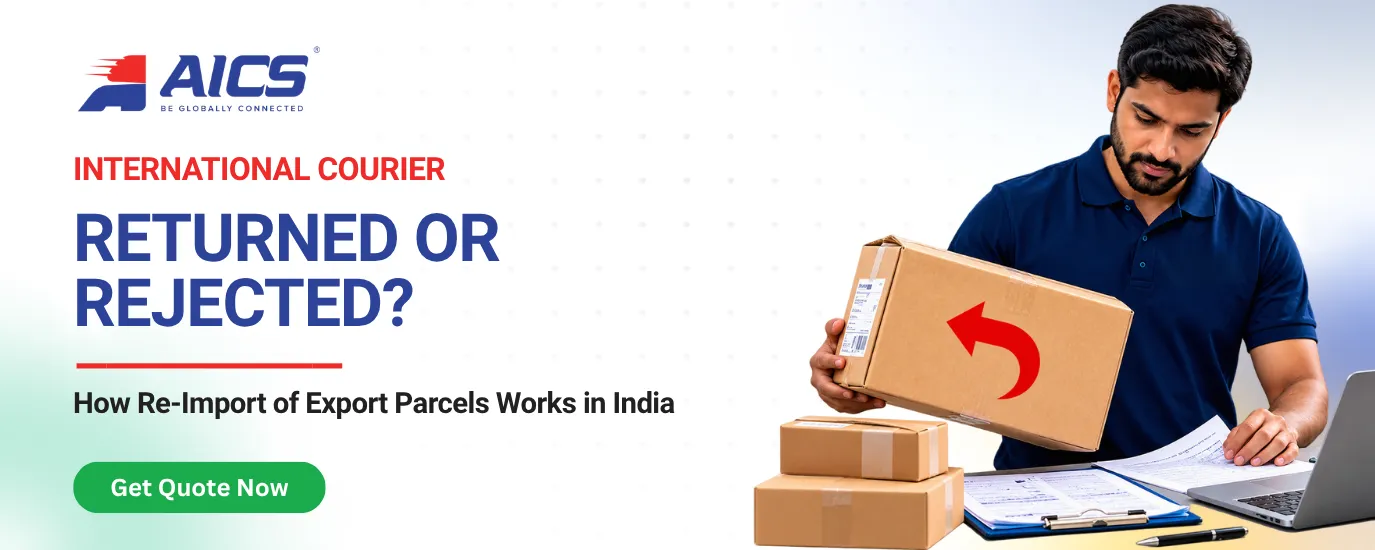
International courier returned to India can happen because of buyer refusal, customs rejection, an incorrect address, an unreachable recipient, or an e-commerce return.
When an export parcel is returned to India, the process changes from exporting goods to bringing the exported goods back through the applicable re-import process.
This is known as re-import of returned export goods. In 2026, India simplified important parts of the courier re-import process in India for returned and rejected goods, including e-commerce returns. This is especially important for MSMEs, D2C brands and exporters dealing with international courier returns in India.
Quick Answer: What Happens When an Export Courier Is Returned to India?
An international courier returned to India may be treated as a re-import of exported goods when goods previously exported from India are returned or rejected overseas. The shipment must be linked to the original export and processed under the applicable customs procedure.
Under CBIC Circular No. 17/2026-Customs, returned and rejected goods, including e-commerce returns, are handled under the applicable re-import framework. The 2026 reforms introduced a risk-based approach and changes to the ECCS process for courier returns and rejects.
Customs duty on a returned export parcel is not automatically waived. Eligible goods may receive re-import duty relief subject to applicable conditions, documentation and, where required, neutralisation of export benefits such as drawback or IGST refund.
Why Do International Courier Shipments Get Returned?
A return can happen at several stages of an international courier shipment from India. The most useful response is to identify the actual reason rather than treating every return as a customs problem.
Understanding why an international courier returned to India can help exporters identify whether the problem was caused by the recipient, destination customs, documentation or delivery information.
1. Receiver Refused or Did Not Accept the Parcel
The consignee may refuse the shipment because of duties/taxes, an unexpected order, damaged packaging, cancellation, or a commercial dispute.
2. Incomplete or Incorrect Address
A missing apartment number, wrong postcode, incomplete business name or invalid delivery address can make the parcel undeliverable.
3. Receiver Could Not Be Contacted
Destination couriers or customs may need the recipient to submit documents, pay duties or confirm information. If the phone number or email is wrong—or the receiver does not respond—the shipment can stall and eventually return.
4. Destination-Country Import Requirement Was Not Met
Products such as food, medicines, cosmetics, electronics, batteries, plant/animal-origin goods and regulated commercial products may require destination-specific approvals or documentation. A shipment acceptable for export from India is not automatically admissible in the destination country.
5. Product Description, Value or Documents Were Inadequate
Vague descriptions, inconsistent values, missing invoices, incomplete consignee information or unsupported claims such as “gift” can trigger questions or rejection.
6. E-commerce Customer Return
Cross-border online sales naturally create returns for size, quality, preference, cancellation or fulfilment reasons. The customs treatment still needs to connect the e-commerce export return with the earlier export.
Re-Import vs Return to Origin: Do Not Mix Up These Two Rules
India’s 2026 courier reforms use “return” in more than one context, and this is where many summaries become confusing.
Re-import of returned/rejected export goods means goods that originally left India are coming back to India.
Return to Origin (RTO), under the new ECCS mechanism, deals with imported goods that have arrived in India but remain uncleared or unclaimed at an International Courier Terminal and are being sent back to the foreign origin.
Therefore, the 15-day RTO rule should not be quoted as a general waiting period for every returned export parcel in India.
When an international courier returned to India contains goods that were originally exported from India, the shipment should be connected to the original export records before the applicable re-import process is completed.
What Changed for Returned and Rejected Courier Goods in 2026?
CBIC Circular No. 17/2026-Customs, dated 31 March 2026, identified re-import of returned and rejected goods as one of the courier reforms to be simplified. The circular notes that the earlier process under Notification No. 45/2017-Customs could be difficult because customs and exporters had to establish that the goods coming back were the same goods that had been exported.
CBIC introduced a risk-based approach and amended the relevant customs notification through Notification No. 08/2026-Customs dated 30 March 2026. The Courier Bill of Entry form was also amended, and DG Systems developed a dedicated return module in ECCS for courier returns and rejects, including e-commerce returns.
For exporters, the practical message is not that verification has disappeared. It is that the system has been redesigned to make legitimate courier returns and re-imports easier to process while still preserving the link between the original export and the re-import.
What Changed for Returned and Rejected Courier Goods in 2026?
CBIC Circular No. 17/2026-Customs, dated 31 March 2026, identified re-import of returned and rejected goods as one of the courier reforms to be simplified. The circular notes that the earlier process under Notification No. 45/2017-Customs could be difficult because customs and exporters had to establish that the goods coming back were the same goods that had been exported.
CBIC introduced a risk-based approach and amended the relevant customs notification through Notification No. 08/2026-Customs dated 30 March 2026. The Courier Bill of Entry form was also amended, and DG Systems developed a dedicated return module in ECCS for courier returns and rejects, including e-commerce returns.
For exporters, the practical message is not that verification has disappeared. It is that the system has been redesigned to make legitimate courier returns and re-imports easier to process while still preserving the link between the original export and the re-import.
Can Returned Export Goods Come Back Without Paying Import Duty Again?
Potentially, yes—but only where the applicable re-import exemption conditions are satisfied.
Notification No. 45/2017-Customs provides customs-duty relief for specified re-imported goods subject to conditions. CBIC’s 2026 circular specifically refers to returned/rejected goods being treated under this framework and notes conditions such as the goods being the same goods that were exported and the neutralisation of export benefits such as drawback or IGST refund where applicable.
The exact duty outcome depends on the original export, the goods, benefits claimed, timing and supporting records. Exporters should therefore avoid promising that every international courier returned to India is automatically duty-free.
What Does “Neutralising Export Benefits” Mean?
An exporter may have received or claimed a benefit because the goods were treated as an export. If those same goods return to India, the law may require the relevant benefit to be repaid, reversed or otherwise neutralised before re-import duty relief is available.
Examples mentioned by CBIC include drawback and IGST refund. The applicable treatment should be checked against the actual export documentation and the current customs notification rather than assumed from the order value alone.
Documents and Evidence to Keep for a Returned Export Parcel
The best time to prepare for a returned export parcel in India is before the original export leaves India. Keep a shipment file that makes the export-to-return trail easy to prove.
- Original commercial invoice or export invoice
- Original Air Waybill (AWB) / courier tracking reference
- Courier Shipping Bill or other export declaration reference, where applicable
- Packing list for multi-item or multi-package commercial shipments
- IEC and GST details where applicable to the export
- Proof of the reason for return or rejection
- Evidence that the returning goods correspond to the original exported goods: SKU, model, serial number, quantity, photographs or other identifiers where relevant
- Records of export benefits claimed, such as drawback or IGST refund, where applicable
- Return AWB / inbound courier reference and any documents requested by the authorised courier or customs
The exact document set varies by shipment and courier procedure. Treat this list as a preparation checklist, not as a universal statutory list for every return.
Keeping an accurate commercial invoice for export courier shipments is important because the original export documentation may be required when goods return to India.
A Practical Re-Import Workflow for Exporters
Step 1: Identify Why the Shipment Is Returning
Get the courier exception or return reason first. A refused delivery, customs rejection, bad address and buyer return can require different supporting evidence.
Step 2: Match the Return to the Original Export
Locate the original invoice, AWB, export declaration and product identifiers. If the goods cannot be linked convincingly to the original export, the re-import process for returned goods becomes harder.
Step 3: Check Whether Export Benefits Were Claimed
Confirm whether drawback, IGST refund or another relevant benefit was taken. If so, determine the neutralisation requirement before relying on re-import duty relief.
Step 4: Share the Return Evidence with the Courier / Customs Handling Team
Provide the original export references and the return reason before the parcel arrives where possible. This helps the handling team select the correct process and request missing documents early.
Step 5: Complete the Applicable Re-Import Declaration
Courier-mode returns are processed through the applicable ECCS/customs workflow by the authorised courier. The exporter/importer should supply accurate data and supporting documents rather than trying to reuse an ordinary personal-parcel declaration.
Step 6: Respond Quickly to Customs Queries
If customs asks for proof of identity, export linkage, value, benefits or return reason, delays in replying can increase storage and handling time.
Step 7: Inspect the Goods After Return
For a commercial seller, record whether the goods are resalable, repairable, damaged or unsuitable for another export. That information should feed back into packaging, product pages and fulfilment decisions.
Example: A D2C Order Is Returned from the UK
Consider an Indian D2C brand that sends a commercial parcel to a UK customer. The customer cancels after dispatch and the parcel is returned to India.
The seller should preserve the original export invoice, AWB, courier/export declaration references and the buyer/courier return record. If an export benefit was claimed, the seller should check what must be neutralised. The authorised courier can then process the returning parcel under the applicable re-import procedure in India using the required customs data.
This is different from simply receiving a new import from the UK: the key fact is that the goods were previously exported from India and are now returning.
How E-Commerce Sellers Can Reduce International Returns
Not every return is preventable, but many avoidable international courier returns from India start with weak order or shipment data.
- Validate the full overseas delivery address and postcode before dispatch.
- Use a reachable receiver phone number and email address.
- Show duties/taxes and import responsibility clearly at checkout where possible.
- Use specific product descriptions and consistent invoice values.
- Check destination restrictions before accepting the order for regulated goods.
- Keep SKU/serial-number or other identity records for products likely to be returned.
- Use export-ready packaging so damage does not become the reason for rejection.
- Set a clear cross-border return policy that explains who pays return shipping and duties/fees.
- Monitor tracking exceptions and contact the receiver before the parcel reaches a return decision.
- For repeated lanes/products, record return reasons and fix the highest-frequency causes.
Sellers should also check restricted items in international courier before dispatch to reduce the risk of destination-country rejection or return.
Where AICS Fits When a Shipment Is Returning
A returned international courier shipment is both a customs problem and a logistics problem. Before the parcel moves back, the exporter needs to know why it is returning, whether the goods can be re-imported under the applicable relief, what documents connect it to the original export and which courier/customs workflow will be used.
AICS can support international courier and export-shipment customers with shipment-level logistics and documentation guidance. For a returned commercial shipment, share the original AWB, invoice, export reference, product details, return reason and inbound tracking information so the case can be reviewed before the next action.
AICS should not promise automatic duty exemption or customs approval. Those outcomes depend on the legal conditions and customs assessment of the actual shipment.
A returned export shipment may require proper customs clearance for international courier shipments, depending on the goods, export history and applicable customs procedure.
Frequently Asked Questions (FAQs)
If goods previously exported from India are sent back, the incoming shipment is a re-import. The exporter should link it to the original export and follow the applicable courier/customs re-import process.
Not necessarily. Re-import duty relief may be available under Notification No. 45/2017-Customs subject to applicable conditions. The shipment’s export history, identity and any export benefits claimed matter.
Keep the original invoice, AWB, export declaration/shipping bill reference where applicable, packing list, product identity records, return evidence and records of any export benefits claimed.
Not as a general rule. The 15-day ECCS RTO mechanism is for imported goods lying uncleared or unclaimed at Indian International Courier Terminals and being sent back to foreign origin. Re-import of an Indian export is a different process.
Important records include the original invoice, AWB, export declaration, product identification details, return evidence and applicable export-benefit records.
Yes, the 2026 CBIC reforms specifically address courier-mode returns and rejects, including e-commerce returns, subject to the applicable customs procedure and conditions.
No courier should guarantee a customs decision. AICS can help with logistics and documentation guidance, but final clearance and duty treatment depend on customs and the facts of the shipment.
Conclusion
A returned international courier is not just a delivery failure; for an exporter, it becomes a re-import transaction. The safest workflow is to preserve the original export trail, record the exact reason for return, check whether export benefits need to be neutralised and give the authorised courier the documents needed to link the incoming parcel to the original export.
India’s 2026 courier reforms make legitimate returned and rejected export shipments easier to process, but they do not remove the need for evidence or customs compliance.
If an AICS export shipment is being returned or rejected, share the original AWB, invoice, product details and return reason with the AICS team before taking the next step.