
Introduction
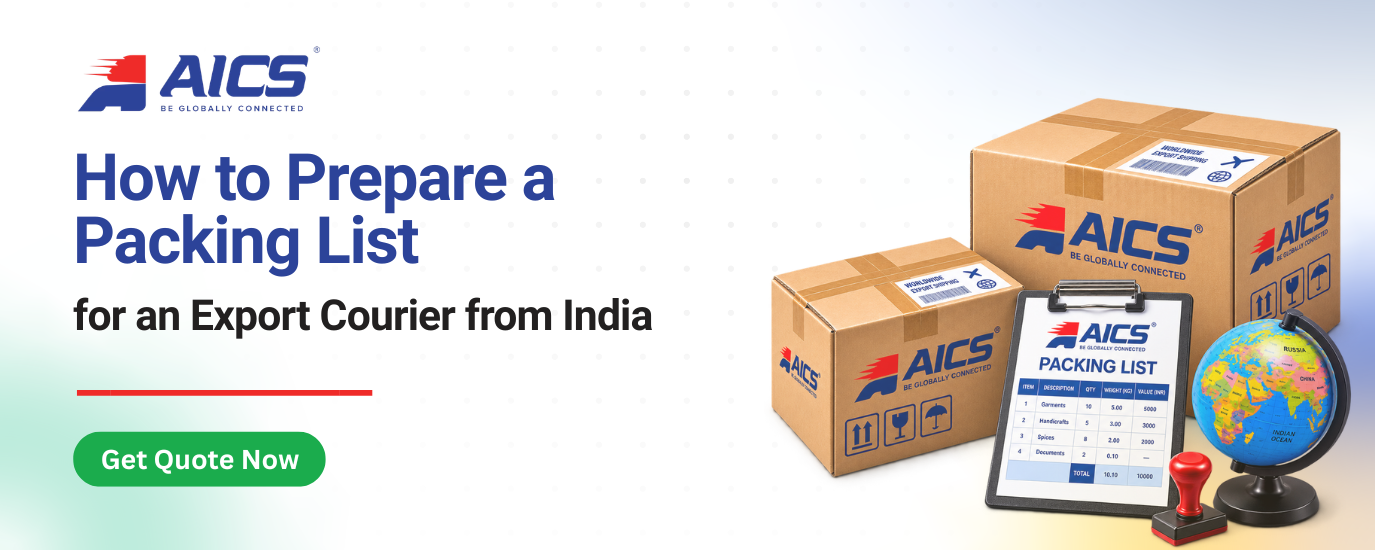
Packing list for export courier India should clearly show how the goods are divided among the shipment’s packages. It records each package number, the items and quantities inside each package, packaging type, net and gross weight, dimensions, marks or references, and shipment totals. Before courier pickup, these details should be matched with the commercial invoice, airway bill data and the sealed physical parcels.
An export packing list is a physical-shipment record, not simply a list of product names. Its purpose is to help the exporter, authorised courier, customs team and receiver identify what is inside each package without relying on the commercial invoice as a box-by-box package map.
For an international courier from India, the packing list should be prepared using the final physical shipment details. Package numbers, item quantities, weights and dimensions should be accurate and consistent across the relevant shipment records.
Before you start: Check whether the goods are eligible for the destination and courier route before sealing them. Review the AICS restricted-items guide and the wider international courier document guide before preparing the final shipment documents.
What Does an Export Packing List Do?
An export packing list describes the physical organisation of a consignment: how many packages there are, how they are identified, what each package contains, and how much each one weighs and measures. It supports handling, inspection and document reconciliation.
The packing list should be detailed enough for someone to locate a product line in a specific box, carton, crate or other package. If all quantities appear only as one shipment total, the document may not perform that package-level function when the consignment contains multiple packages.
The packing list should agree with the commercial invoice, but the two documents have different purposes. The commercial invoice records the parties, goods, value and transaction or export purpose. The packing list maps the goods to the physical packages. Use the AICS commercial invoice field checklist when preparing the value record.
Is a packing list required for courier exports from India?
A packing list for export courier India helps show how goods are divided among the shipment’s packages. India’s DGFT lists a Commercial Invoice cum Packing List among the mandatory export documents for goods, while separate Commercial Invoice and Packing List documents are also accepted. Product-specific controls may require additional records. DGFT Foreign Trade Policy – Chapter 2.
Direct answer: You may use a properly prepared combined document or two separate documents, but the information should cover both commercial-invoice and package-level requirements.
Courier shipments are also subject to applicable customs procedures and courier regulations. Refer to the CBIC Courier Imports and Exports Regulations for the relevant regulatory framework. CBIC Courier Imports and Exports Regulations The exporter must provide complete and accurate shipment information.
A pure document shipment can follow a different route from a shipment of goods. Do not label a parcel containing products, samples or sale goods as “documents” merely because the paperwork is simpler.
When preparing a packing list for export courier India, make sure every package is clearly numbered and its contents, quantity, weight and dimensions are accurately recorded.
What information should an export packing list contain?
| Section | Information to prepare | Control purpose |
|---|---|---|
| Document identity | Packing-list number or reference and issue date | Connects the list to the correct shipment version. |
| Invoice reference | Related commercial-invoice number and date | Links physical package data to the commercial/value record. |
| Exporter | Legal name, full address and contact details | Identifies the party preparing the shipment record. |
| Consignee | Full legal name, address, country and contact details | Helps match the document to the intended receiver. |
| Shipment reference | Buyer reference, order number or airway-bill reference when available | Connects related operational records without replacing them. |
| Package count | Total number of packages and package type | Must agree with booking data and the physical handover. |
| Package identity | Box/carton/crate number, such as “Package 1 of 3” | Allows package-by-package verification. |
| Marks and numbers | Shipping marks, labels or handling references where used | Connects the document row to the label on the package. |
| Item description | Specific product description, model/SKU or material/use detail where relevant | Should reconcile with the invoice and actual contents. |
| Quantity | Quantity and unit of measure for every line inside each package | Supports line-by-line and package-level totals. |
| Net weight | Weight of the goods excluding external packaging, where applicable | Separates product weight from packing material. |
| Gross weight | Final packed weight of each package | Should reflect the sealed handover unit. |
| Dimensions | Final outer length, width and height with the unit stated | Supports identification and booking data consistency. |
| Origin/classification | Country of origin and HS/HSN code when requested or included in the chosen format | Must match verified commercial/customs records. |
| Totals | Total packages, total quantities, total net weight and total gross weight | Provides a shipment-level reconciliation point. |
| Approval | Name, role, signature or authorised digital approval where applicable | Shows which controlled version was released. |
Describe goods specifically
Use the same clear product language across the packing list and commercial invoice. A description such as “parts,” “samples,” “gift items” or “general merchandise” may not identify the goods. Add the product name and distinguishing information relevant to classification or identification, without inserting unsupported technical claims.Measure the final package, not an early estimate
Record outer dimensions and gross weight after the goods, cushioning and outer packaging are final. If the box or contents change, update the packing list and related booking data before handover. The courier may apply its own measurement and verification process.
Make every unit explicit
Write the unit beside quantities, dimensions and weights. Do not make the reviewer guess whether a measurement is in centimetres or inches, or whether a weight is in kilograms or another unit. Use one consistent unit system across package rows and totals unless the receiving process requires otherwise.
Packing list vs commercial invoice vs airway bill
| Document | Main question answered | Typical information | It does not replace |
|---|---|---|---|
| Packing list | How are the goods physically packed? | Package number, contents, quantities, net/gross weight, dimensions and marks | The value/transaction record or transport record |
| Commercial invoice | Who is exporting what, for what value and purpose? | Exporter, buyer/consignee, product, quantity, value, currency, origin and commercial/export details | The box-by-box package map or airway bill |
| Airway bill | What shipment has the carrier accepted for transport? | Shipper, consignee, route, package count, weight and carrier reference | The detailed commercial invoice or package-content breakdown |
| Courier export declaration | What export particulars are filed with Customs? | Applicable electronic declaration data submitted through the authorised courier | The exporter’s accurate source documents and physical goods |
How do you prepare the packing list before courier pickup ?
1. Confirm shipment eligibility. Check the goods, purpose, destination and any product-specific restrictions before final packing.
2. Freeze the invoice product lines. Confirm the final product descriptions, quantities and identifiers that will appear on the commercial invoice.
3. Pack and number every package. Give each sealed handover unit a clear number and use the same number on the label and packing list.
4. Allocate every item to a package. Show the description, quantity and unit inside each numbered package instead of listing only shipment totals.
5. Measure final weights and dimensions. Record net weight where applicable, final gross weight and external dimensions with units.
6. Calculate document totals. Sum package count, line quantities, net weight and gross weight; investigate any inconsistency.
7. Run the four-way match. Compare the packing list with the commercial invoice, booking/airway-bill data and physical parcels.
8. Release one controlled version. Date and approve the final list, then replace superseded copies used by the packing, accounts and pickup teams.
The AICS four-way packing-list check
Use this review immediately before pickup. A match means the records describe the same shipment; it does not guarantee customs clearance or destination acceptance.
1. Commercial invoice
- Do product descriptions and identifiers agree?
- Do the packing-list quantities total to the invoice quantities?
- Are origin and classification details consistent where they appear on both documents?
- Does the invoice reference on the packing list point to the current invoice version?
2. Packing list
- Is every package numbered and every item allocated to a package?
- Are units stated for quantity, weight and dimensions?
- Do package totals equal the shipment totals?
- Is gross weight logically equal to or greater than the relevant net weight?
3. Booking and airway-bill data
- Do shipper and receiver details identify the same parties?
- Does package count match the packing list?
- Do the submitted weight and dimensions reflect the final packages?
- Does the shipment description remain consistent without becoming vague?
4. Physical parcels
- Does each parcel carry the package number shown on the list?
- Are the actual contents and quantities in the stated package?
- Were any products added, removed or moved after the document was prepared?
- Are old or conflicting labels and draft documents removed from the handover set?
Which packing-list errors can trigger a correction or query?
| Error | Why it matters | Pre-pickup control |
|---|---|---|
| Package count mismatch | The document, booking record and physical handover describe different shipments. | Count sealed packages and reconcile the total everywhere. |
| Invoice quantity mismatch | The physical breakdown does not add up to the commercial record. | Sum packing-list lines against each invoice line. |
| Vague item descriptions | The goods cannot be identified confidently from the document. | Use specific, consistent descriptions and identifiers. |
| Missing package allocation | A multi-package consignment has totals but no box-by-box map. | List contents beneath each package number. |
| Estimated weights after packing changed | The final parcel differs from the submitted record. | Remeasure after repacking and update all related records. |
| Units omitted or mixed | Numbers can be interpreted incorrectly. | State and standardise units for every quantity and measurement. |
| Duplicate package numbers | Two boxes cannot be distinguished from the list. | Use one unique package identifier per physical unit. |
| Old version sent to pickup team | The handover set does not reflect final contents. | Use a dated approved version and withdraw superseded copies. |
For context on document review and customs processing, read the AICS international courier customs-clearance guide.
Frequently Asked Questions (FAQs)
Not necessarily. DGFT states that a Commercial Invoice cum Packing List is part of the mandatory export-document set and that separate documents are also accepted. Your combined format must still include the package-level breakdown and commercial details required for the actual shipment.
A separate packing list usually focuses on package contents, quantities, weights and dimensions, while the commercial invoice carries value and currency. If you use a combined document or a courier, buyer or authority requires value data on the packing list, include it consistently with the commercial invoice.
A single package can still need a packing list or combined invoice-cum-packing list. Identify it as one package and list all contents, quantities, weights and final dimensions. Confirm the required format with the courier for the specific shipment.
The exporter or consignor normally supplies the accurate source information and controls the final packing list. A courier or agent may provide a template or review it, but the underlying contents, quantities and package details must reflect the actual shipment.
You can draft it during packing, but final weights, dimensions, package count and contents should be confirmed after packing is complete. If anything changes, update the controlled version before handover.
Ask which measurement is being used and correct the packing list or booking data if your record is inaccurate. Do not alter product quantities or descriptions merely to force the documents to match a measurement; investigate the physical cause.
Include verified HS/HSN codes if the selected template or shipment process requires them. Where the code appears on more than one document, it should remain consistent. Classification should be verified rather than guessed from a similar product.
Reuse a controlled structure, not unverified content. Fields can change with the product, buyer, destination, number of packages, courier process and regulatory requirements. Review the template for each shipment.
Prepare the physical record before the parcel moves
A useful export packing list lets another person answer three questions quickly: how many packages exist, what is inside each one, and whether the package data matches the rest of the shipment record. Build it from the final parcel, not from an early estimate.
Action: Need a pre-pickup document check? Review AICS export-shipment services, request a current shipment-specific quote, or contact AICS Logistics. Share the destination, shipment purpose, item list, package count, final weights and dimensions. Final acceptance and customs treatment remain subject to the goods, route, courier and applicable authorities.