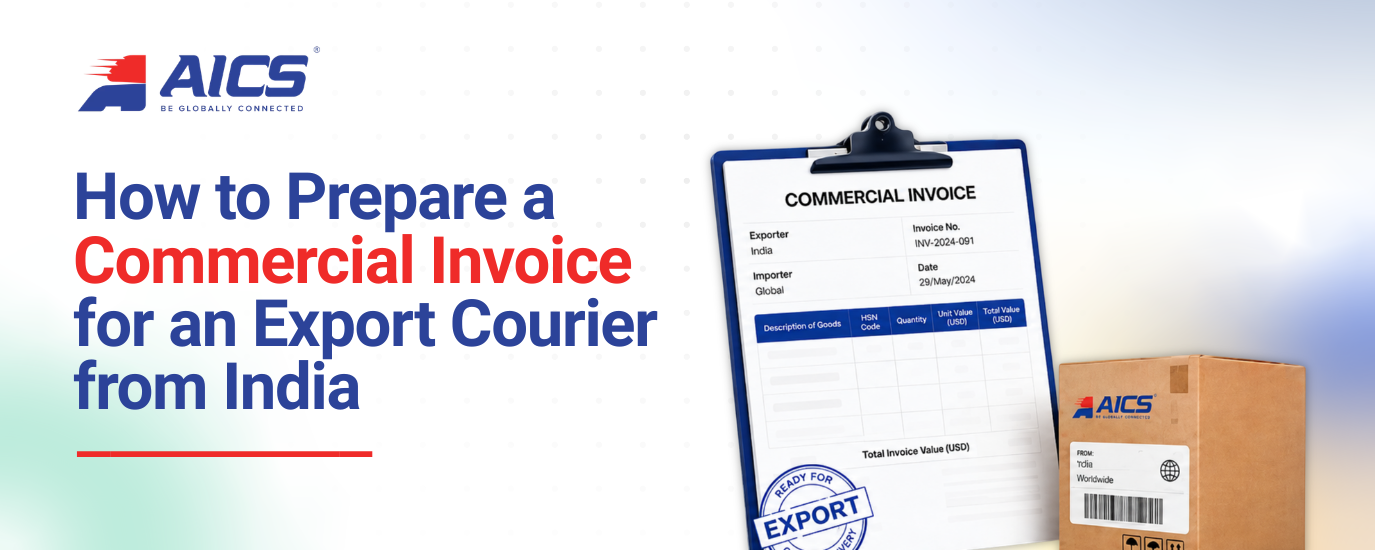
How to Prepare a Commercial Invoice for an Export Courier from India
Direct answer: A commercial invoice for export courier from India should identify the exporter and overseas recipient, describe every product precisely, state quantity and value, show the relevant classification and origin details, and match the packing list and courier declaration. Indian export rules can also require an airway bill and shipping bill, while regulated products may need additional documents.
Action: Before you seal the carton: ask AICS to confirm which shipment details and supporting documents are needed for your product and destination. Check export-shipment documents
What Does a Commercial Invoice Do for a Courier Export?
A commercial invoice records the parties, goods and value behind an international shipment. Customs and the authorised courier use its details to understand what is leaving India, why it is being exported and how the goods should be declared. It is not a substitute for the airway bill or the applicable courier shipping bill.
The Directorate General of Foreign Trade lists an airway bill or equivalent transport record, a commercial invoice-cum-packing list, and a shipping bill or bill of export among the mandatory documents for export of goods. Separate commercial invoices and packing lists are also accepted. Product-specific laws can add certificates, permits or other evidence. See DGFT Foreign Trade Policy, Chapter 2.
For a broader document set by shipment type, use AICS’s international courier document guide before preparing the invoice.
When is a commercial invoice required?
Prepare a commercial invoice when physical goods cross a border and the shipment needs a customs value and product declaration. A pure document shipment with no commercial value is treated differently, but a parcel containing products, samples, ecommerce orders or business goods should not be labelled as “documents” simply to avoid paperwork.
The exact declaration route depends on the shipment purpose. India’s courier regulations distinguish documents, gifts or samples, and commercial goods. They also require the sender’s declaration to state the contents and total value of each package. The authorised courier files the applicable electronic courier export declaration; the sender supplies accurate underlying information. See the CBIC courier export regulations.
If you are unsure whether the parcel is personal, a sample, or a commercial export, pause before writing the invoice. The reason for export, payment arrangement and actual use should agree with one another.
What Information Should a Commercial Invoice for Export Courier from India Contain ?
Start with the fields below, then confirm additions required by the destination country, product regulator, buyer, bank and courier. A field being common does not make it optional in every case, and the same template should not be reused blindly for different goods.
| Section | Information to prepare | Why it matters |
|---|---|---|
| Invoice identity | Unique invoice number and issue date | Connects the invoice to accounting, customs and shipping records. |
| Exporter | Legal name, full address, contact details and GSTIN/IEC where applicable | Identifies the party exporting from India. |
| Consignee and buyer | Full legal name, address, country, phone/email, and buyer details if different | Helps customs and delivery teams identify the receiving parties. |
| Shipment purpose | Sale, sample, repair, return, gift or another truthful reason | Helps determine the correct declaration route and supporting evidence. |
| Product line | Specific item name, material/composition, intended use or model/SKU where relevant | Vague descriptions make classification and admissibility checks harder. |
| Classification | Applicable HSN/HS or destination tariff code after verification | Links each product to trade-policy and customs treatment. |
| Quantity and unit | Number of units and unit of measure | Must reconcile with the packing list and physical contents. |
| Value | Unit value, line value, total value and currency | Supports customs valuation and the commercial record. |
| Origin | Country of origin or manufacture for each product where required | Used for origin, tariff and product-control decisions. |
| Delivery terms | Agreed Incoterm and named place where the transaction uses one | Clarifies the buyer’s and seller’s cost and responsibility split. |
| Package references | Number of packages, marks and gross/net weight where relevant | Helps match goods to the packing list and airway bill. |
| Declaration | Required export/GST wording and authorised signature or digital signature | Confirms the invoice and tax/export treatment where applicable. |
Use a product description that can be classified
“Sample,” “parts,” “garment” and “gift item” do not tell customs what the product is. Build each line from factual attributes already present in the product record:
Direct answer: Item type + material/composition + model or use + quantity
Do not add an unverified HS code merely to fill a box. DGFT explains that India’s ITC (HS) classifies goods at the national level and links classifications to import/export policy. Confirm the code against the current product specifications and the relevant official tariff or an appropriately qualified adviser.
State a defensible value, including for samples
“Sample,” “parts,” “garment” and “gift item” do not tell customs what the product is. Build each line from factual attributes already present in the product record:
Direct answer: Item type + material/composition + model or use + quantity
Do not add an unverified HS code merely to fill a box. DGFT explains that India’s ITC (HS) classifies goods at the national level and links classifications to import/export policy. Confirm the code against the current product specifications and the relevant official tariff or an appropriately qualified adviser.
Keep the currency and totals unambiguous
Use one clearly named currency for the unit and total values unless the transaction genuinely requires more. Recalculate line totals, discounts, freight or insurance entries and the final invoice value before sending the document to the courier. Avoid currency symbols that could be read in more than one way.
What changes when the exporter is GST-registered?
A GST-registered exporter should confirm that the export invoice also meets the applicable tax-invoice rules. Rule 46 of the CGST Rules lists particulars including supplier and recipient details, invoice number and date, HSN, description, quantity, values, tax information and signature. For exports, it also specifies an export endorsement and destination-country details.
The correct wording and tax treatment depend on whether the export is made with payment of integrated tax or under bond or Letter of Undertaking without payment. Check the current CBIC CGST Rules, Rule 46 and have your tax adviser confirm the invoice treatment for the transaction. A courier cannot determine the exporter’s GST position from the carton alone.
Commercial invoice vs pro forma invoice vs packing list
These documents answer different questions. Sending one file under the wrong name can leave the operational team without the record it needs.
| Document | Main purpose | Typical contents | Practical caution |
|---|---|---|---|
| Commercial invoice | Final commercial and customs record for shipped goods | Parties, products, quantity, value, currency, origin and transaction details | Should reflect the shipment actually dispatched. |
| Pro forma invoice | Pre-shipment quotation or preliminary statement | Expected products, quantities, prices and terms | Do not assume it replaces the final commercial invoice for a completed sale. |
| Packing list | Physical breakdown of cartons and contents | Package count, item allocation, marks, dimensions and weights | Quantities and package references must agree with the invoice. |
DGFT permits a commercial invoice-cum-packing list or separate documents. Combining them can be practical for a simple consignment, but only if the document contains both the commercial information and the package-level detail required for the shipment.
How do you prepare the invoice before courier pickup?
Use this order so that the invoice is built from verified shipment data, not copied from a previous parcel.
- Confirm the shipment purpose. Record whether the goods are sold, sampled, returned, repaired or sent for another genuine reason.
- Verify exporter and recipient identities. Match legal names, addresses and contact details with the commercial record and shipment booking.
- Create the product lines. Use exact descriptions, quantities, units, origin and verified classification information.
- Calculate values and currency totals. Check every line and preserve evidence supporting the declared value.
- Match the packing list. Reconcile the number of units, cartons, weights and package marks before sealing.
- Apply the correct tax/export wording. If GST-registered, confirm the Rule 46 endorsement and tax treatment with the appropriate adviser.
- Send the final file for the courier declaration. The authorised courier uses shipment information to file the relevant courier export form. Keep the signed or digitally approved version in the export record.
If the goods may be restricted, licensed or product-regulated, stop before pickup and check the international courier restricted-items guide alongside the destination authority’s rules. An accurate invoice does not make an ineligible item eligible.
Which commercial invoice errors cause customs queries?
Most invoice problems are inconsistencies rather than missing decoration. A polished template will not help if its core facts disagree with the parcel or another declaration.
- The exporter, consignee or buyer name is incomplete or inconsistent.
- The product description cannot be classified from the words used.
- Invoice quantity does not match the packing list or physical contents.
- The reason for export conflicts with payment or order records.
- A sample is given an unsupported zero or nominal value.
- The wrong currency is selected or totals do not add up.
- The country of origin is omitted or confused with the country of dispatch.
- A copied HS code does not match the actual product.
- GST export wording is missing or does not match the chosen tax route.
- Product permits, certificates or destination documents are treated as optional because the invoice is complete.
When a shipment is held for document review, use AICS’s explanation of how customs clearance works for international courier to identify which record may need correction or supporting evidence.
The AICS three-way invoice check
The original checklist for this article reduces the review to three comparisons. It is a preparation framework, not a substitute for customs, tax or product-regulatory advice.
1. Parties and purpose
Do the exporter, buyer, consignee and shipment purpose match the order, payment arrangement, KYC and booking information?
2. Goods and value
Do the description, material, quantity, classification, origin, unit value, total value and currency match the actual goods and business records?
3. Packages and declaration
Do the cartons, weights and package marks match the packing list and airway bill, and has the correct export/GST wording been confirmed?
Download the printable Commercial Invoice Pre-Pickup Checklist and run this review before handing over the parcel.
Action: Preparing a commercial courier export? Share the product, destination, approximate weight and package dimensions with AICS for a current shipment review and quotation. Review export-shipment service Request a current quote
Frequently Asked Questions (FAQs)
A pure document shipment with no commercial value is normally handled differently from a goods shipment. Do not use the document category for products, samples or merchandise. Confirm the contents and declaration route with the courier before pickup because the destination or document type may still require supporting information.
A pro forma invoice is generally a preliminary quotation or statement, while a commercial invoice records the goods actually shipped and the completed transaction. Carrier and destination requirements vary, so confirm which final document is required rather than renaming a preliminary file.
Being free to the recipient does not necessarily mean the goods have no customs value. State the sample purpose truthfully and use a supportable value. The valuation method and any additional sample declaration should be checked for the product and destination.
Their treatment depends on the transaction terms, valuation rules and invoice format. If they are shown, label them separately and make sure the total agrees with the chosen Incoterm and the commercial record. Ask the buyer or adviser to resolve unclear cost allocation before dispatch.
Under India's courier export regulations, the authorised courier or its qualified agent files the applicable electronic courier export entry. The exporter remains responsible for providing accurate product, value, party and purpose information that supports that filing.
DGFT accepts a combined commercial invoice-cum-packing list and also accepts separate documents. A combined document must still contain adequate commercial and package-level information. For multi-carton or mixed-product consignments, a separate packing list often makes reconciliation clearer.
DGFT states that an IEC is mandatory for export/import activities unless a specific exemption applies. Do not assume an exemption from shipment value or courier mode alone. Check the current DGFT provisions and your exporter status before booking.
The layout can be reused, but the content and supporting documents must be reviewed for each product, purpose and destination. Import permits, product certificates, labelling, tariff codes and consignee data can change the required document set.
Prepare the record before the parcel moves
A commercial invoice works when it describes the real shipment in language that accounting, customs and the courier can all reconcile. Build it from current product and transaction records, match it to the packing list, and resolve classification, GST or destination questions before pickup. That small pause is cheaper than correcting documents after the parcel enters the export network.
Action: Ready for a document check and shipping quote? Contact AICS Logistics with the pickup city, destination country, item description, quantity, approximate weight and carton dimensions. Ask AICS on WhatsApp Use the enquiry form.