Introduction
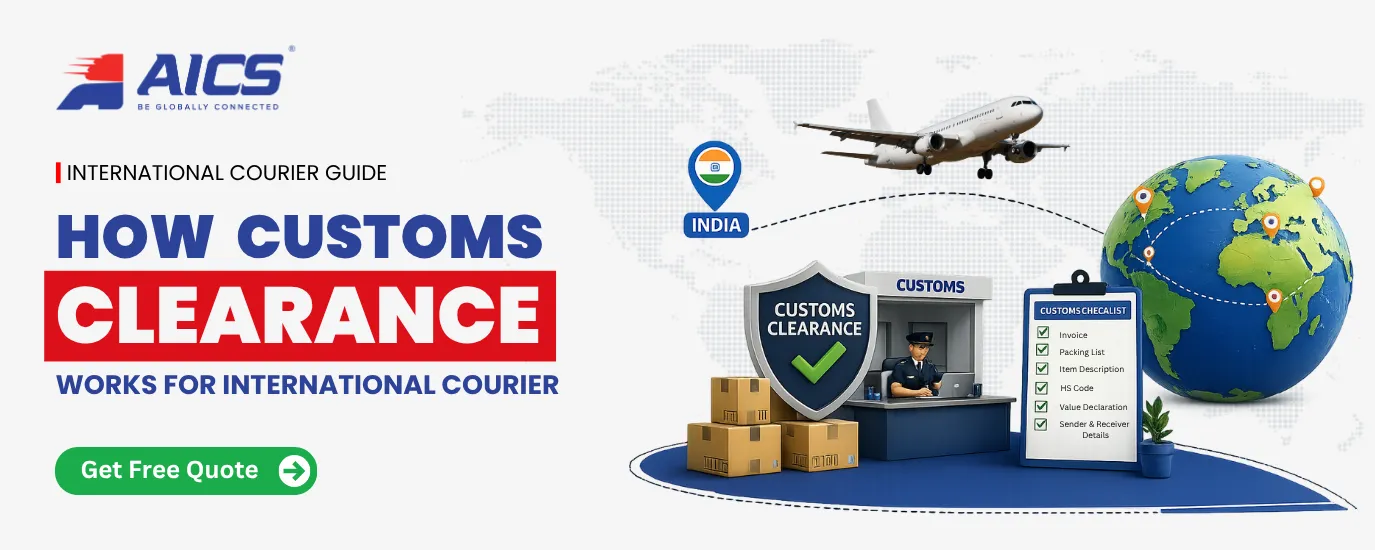
Customs clearance is one of the most important stages of international courier shipping. Many customers assume that once a parcel is picked up, it directly reaches the receiver. In reality, every international shipment must pass through customs checks before it can legally leave India and enter the destination country.
Whether you are sending documents, medicines, food items, student luggage, personal parcels, gifts, samples, e-commerce orders, or commercial shipments, customs clearance decides whether the shipment can move ahead, whether duties or taxes apply, and whether additional documents are required.
This 2026 guide explains how customs clearance works for international courier from India, why parcels get stuck in customs, what documents are required, how customs duties are calculated, and how customers can reduce delays before booking a shipment.
AICS Logistics supports international courier shipments with doorstep pickup, packing guidance, documentation support, shipment tracking, and customs-related assistance for personal and commercial parcels.
Quick Answer Customs clearance is the process where customs authorities review shipment documents, item declarations, value, product category, restricted-item status, and duty/tax requirements before allowing a parcel to leave India or enter another country. Every international courier shipment is subject to customs procedures. |
Why Customs Clearance Is Required
Customs clearance exists to protect countries, regulate international movement of goods, and ensure that parcels follow import and export laws. Customs authorities check whether the goods are correctly declared, whether the shipment value is accurate, whether the product is restricted, and whether any duties or taxes are payable.
Customs checks help authorities:
- Verify shipment contents and item descriptions
- Prevent illegal, unsafe, counterfeit, or prohibited goods movement
- Protect public health, agriculture, environment, and national security
- Collect applicable import duties, VAT, GST, or other taxes
- Enforce destination-country import regulations
- Check shipment value, HS code, invoice, and declaration accuracy
- Identify restricted products such as medicines, food, batteries, chemicals, and electronics
Without customs clearance, an international courier shipment cannot legally complete its export or import journey.
How Customs Clearance Works: Step-by-Step Process
The exact clearance process can vary by courier network and destination country, but the general flow is similar for most international courier shipments.
Step 1: Shipment Booking
The sender shares shipment details such as pickup address, receiver address, destination country, parcel weight, dimensions, item category, quantity, and declared value. This information becomes the foundation for customs declaration and billing.
Step 2: Item Eligibility Check
Before packing, the courier team should check whether the item is allowed, restricted, conditionally allowed, or prohibited for the destination country. Medicines, food items, batteries, liquids, electronics, cosmetics, plant-based products, animal products, and chemicals require extra checking.
Step 3: Documentation Preparation
The required documents are prepared based on shipment type. Personal parcels may need KYC ID proof, receiver details, packing list, and declaration. Commercial shipments may need commercial invoice, packing list, GST/IEC details, product information, and export documents. Medicines may need prescription, medicine invoice, and personal-use declaration.
Step 4: Customs Declaration
A customs declaration contains the product description, quantity, weight, declared value, country of origin, shipment category, and purpose. Vague descriptions like “gift”, “sample”, or “personal item” may create customs doubts. Specific descriptions such as “cotton clothes for personal use” or “printed educational books” are clearer.
Step 5: Export Customs Clearance in India
Before leaving India, the shipment goes through export customs processing. In courier mode, authorized couriers submit relevant electronic declarations and manifests through customs systems where applicable. Routine shipments usually clear faster when the item description, invoice, packing list, and declaration are accurate.
Step 6: International Transportation
After export clearance, the parcel moves through the international courier or air cargo network. During transit, tracking updates are generated by courier partners and airline/logistics systems.
Step 7: Import Customs Clearance in Destination Country
When the shipment arrives in the destination country, local customs authorities review the shipment declaration, invoice value, item description, product category, import rules, and restricted-item status. Some parcels clear automatically, while others are selected for document verification or physical inspection.
Step 8: Duty and Tax Assessment
If applicable, customs may calculate import duty, VAT, GST, processing fees, or other charges. Duty and tax rules depend on destination country, product category, declared value, HS code, and whether the shipment is personal or commercial.
Step 9: Customs Query, Inspection or Hold
If applicable, customs may calculate import duty, VAT, GST, processing fees, or other charges. Duty and tax rules depend on destination country, product category, declared value, HS code, and whether the shipment is personal or commercial.
Step 10: Customs Release and Final Delivery
Once customs requirements are completed and any duties or taxes are paid, the shipment is released to the local courier network for final delivery to the receiver.
Customs Clearance Flow at a Glance
| Stage | What Happens | Customer Responsibility |
|---|---|---|
| Booking | Shipment details are collected. | Share accurate item, weight, value, and receiver details. |
| Documentation | Invoice, packing list, declaration and supporting documents are prepared. | Keep documents ready before pickup. |
| Export Clearance | Indian customs checks export shipment details. | Avoid restricted items and wrong declarations. |
| Transit | Parcel moves through courier/air network. | Track shipment and stay reachable. |
| Import Clearance | Destination customs reviews the parcel. | Receiver may need to respond to duty/document queries. |
| Duty/Tax | Customs may assess duties, VAT/GST or fees. | Pay applicable charges if required. |
| Release | Parcel is released to local delivery partner. | Ensure receiver is available for delivery. |
What Customs Authorities Usually Check
Customs authorities generally review a combination of shipment data, documents, product category, and compliance rules. The most important checks include:
- Whether the product description matches the actual item inside the parcel
- Whether the declared value looks reasonable and matches the invoice
- Whether the product category is allowed in the destination country
- Whether the product needs permits, prescription, certificates, or special approval
- Whether the parcel contains restricted, prohibited, hazardous, or regulated goods
- Whether duties or taxes apply based on shipment value and product classification
- Whether the sender and receiver details are complete and valid
Customs Duties and Taxes: Simple Explanation
Customs duties and import taxes are not controlled by the courier company. They are assessed by the customs authority of the destination country based on product type, shipment value, product classification, and local import rules.
In many countries, duties are calculated using the customs value of the goods. Customs value usually considers the value of goods and may also include freight and insurance depending on local law. The duty rate is often linked to the product’s Harmonized System (HS) classification.
Not every shipment attracts duties. Documents usually do not attract duty in normal cases, but non-document parcels, commercial goods, high-value shipments, gifts, electronics, food items, medicines, and samples may be assessed depending on destination-country rules.
AICS can guide customers on documentation and shipment process, but final duty, tax, inspection and clearance decisions are made by the customs authority of the destination country.
Why Do International Shipments Get Stuck in Customs?
When tracking shows “held at customs” or “customs clearance pending”, it does not always mean the shipment is rejected. In many cases, the hold is temporary and customs may simply need additional review, documents, or duty payment.
| Reason | What It Means | How to Avoid It |
|---|---|---|
| Missing Documents | Invoice, packing list, prescription or declaration is incomplete. | Prepare required documents before pickup. |
| Vague Description | Descriptions like gift, sample, items or parcel are unclear. | Use specific item descriptions. |
| Restricted Item | Medicine, food, battery, liquid, chemical or electronic item needs extra review. | Check eligibility before packing. |
| Incorrect Value | Declared value looks too low or does not match invoice. | Declare honest and reasonable value. |
| Duty/Tax Pending | Receiver needs to pay applicable customs charges. | Inform receiver in advance. |
| Wrong Receiver Details | Address, phone number or contact details are incomplete. | Verify receiver details before booking. |
| Physical Inspection | Customs selects parcel for additional examination. | Keep documents ready and respond quickly. |
How Long Does Customs Clearance Take?
Customs clearance time depends on shipment type, destination country, customs workload, product category, holidays, and document accuracy. The timelines below are estimated and not guaranteed.
| Shipment Type | Estimated Clearance Time | Notes |
|---|---|---|
| Documents | 1-2 Working Days | Usually fastest when address and paperwork are correct. |
| Personal Parcels | 1-3 Working Days | May take longer if item description is vague. |
| Medicines | 2-5 Working Days | Prescription and invoice may be verified. |
| Food Items | 2-7 Working Days | Food/biosecurity checks vary heavily by country. |
| Student Luggage | 2-5 Working Days | Packing list and personal-use declaration help. |
| Commercial Shipments | 2-7 Working Days | Invoice, product category and export/import compliance matter. |
Documents Required for Customs Clearance
Required documents vary by shipment type, item category, courier network, and destination country. The safest approach is to prepare documents before pickup instead of waiting for customs to request them later.
| Shipment Type | Common Documents Required |
|---|---|
| Personal Shipments | KYC ID proof, sender details, receiver details, packing list, declaration form, and address details. |
| Commercial Shipments | Commercial invoice, packing list, GST details, IEC (if applicable), product details, export documents, and certificates if required. |
| Medicine Shipments | Doctor prescription, medicine invoice, medicine list, personal-use declaration, receiver details, and approval if required. |
| Food Shipments | Product information, ingredient details where required, invoice, packaging details, and destination-country eligibility check. |
| Student Luggage | Passport/ID proof, packing list, personal-use declaration, and student/university proof where applicable. |
| Electronics/Battery Items | Product invoice, product details, battery declaration or approval if required, and packaging compliance. |
Customs Clearance for Different Shipment Types
Documents and Certificates
Documents are usually simpler than non-document parcels, but receiver name, full address, phone number, and document type should still be accurate. University papers, certificates, legal documents, business agreements, and immigration-related documents should be packed securely and labelled correctly.
Medicines
Medicine shipments often receive additional scrutiny because every country has its own health and drug-control rules. Prescription medicines may require doctor prescription, medicine invoice, personal-use declaration, receiver details, and sometimes destination-country approval. Controlled, narcotic, injectable, temperature-sensitive, or restricted medicines should be checked before booking.
Best practice: never send medicines casually without documentation. Missing prescription or incorrect medicine declaration can lead to customs delay, return, confiscation, or rejection.
Food Items
Food items are regulated differently across countries. Dry, sealed, non-perishable food may be accepted in some cases, while meat, dairy, fresh fruits, vegetables, seeds, plant-based materials, and homemade or liquid food may face strict checks. Countries such as Australia, Canada, the USA, the UK and UAE have different food import rules.
Best practice: check food eligibility before packing. For food shipments, ingredient details, product labels, and proper declaration may be important.
Student Luggage
Student luggage shipments usually include clothes, books, bedding, utensils, personal belongings and study materials. Customs clearance is smoother when students provide an accurate packing list, personal-use declaration, receiver details, and supporting student documentation where applicable.
Commercial and Export Shipments
Commercial shipments need more careful documentation than personal parcels. Product samples, e-commerce orders, textile shipments, pharma items, electronics, chemicals, and industrial goods may need commercial invoice, packing list, GST/IEC details, product specifications, HS code, MSDS, certificates, or regulatory approvals depending on product type.
Restricted or Prohibited Items and Customs Clearance
Restricted items are one of the biggest reasons for customs holds. Some products may be allowed only with special documents, while others may be completely prohibited in regular courier channels.
Common restricted or sensitive categories include:
- Medicines without prescription or approval
- Food items, especially meat, dairy, seeds, fresh food, plant-based and homemade items
- Lithium batteries, power banks and electronics with batteries
- Liquids, perfumes, aerosols and cosmetics containing alcohol
- Hazardous chemicals, flammable goods and dangerous goods
- Currency, gold, jewellery and high-value valuables
- Alcohol, tobacco and nicotine products
- Sharp objects, weapons, ammunition and controlled goods
- Counterfeit, illegal or copyright-infringing goods
Final acceptance depends on courier policy, airline safety rules, export regulations, destination-country import laws, and customs clearance.
Common Customs Mistakes to Avoid
- Writing vague item descriptions like “gift”, “sample”, “parcel” or “personal item”.
- Sending medicines without prescription or invoice.
- Sending food items without checking destination-country rules.
- Undervaluing the shipment to reduce duty.
- Using wrong receiver phone number or incomplete address.
- Not providing commercial invoice for business shipments.
- Packing batteries, liquids or restricted items without approval.
- Not informing the receiver about possible duties or taxes.
- Ignoring customs document requests after shipment dispatch.
Tips for Faster Customs Clearance
| Stage | Best Practice |
|---|---|
| Before Shipping | Check item eligibility, prepare documents, declare correct value, avoid restricted products, and use clear item descriptions. |
| During Pickup | Share accurate weight, dimensions, item list, invoices, and supporting documents with the courier team. |
| During Transit | Track shipment regularly and respond quickly if customs or courier requests additional documents. |
| At Destination | Receiver should stay reachable, pay duties/taxes if applicable, and provide documents when requested. |
| After Delivery | Keep invoice, tracking number, and customs-related documents saved for future reference. |
AICS Customs Support: How AICS Helps Customers
Customs clearance can feel confusing for customers, especially when they are sending medicines, food items, student luggage, gifts, export samples or commercial goods for the first time. AICS Logistics simplifies the process with practical shipment support from pickup to delivery.
AICS helps customers with:
- Doorstep pickup support across India
- Packing guidance for international courier shipments
- Simple documentation assistance
- Customs-related guidance based on shipment type
- Medicine, food, student luggage, document and commercial shipment support
- Real-time shipment tracking
- Support for personal and business shipments to 220+ countries
- Transparent quotation support before booking
AICS Positioning Line
AICS cannot override customs decisions, but it can help customers prepare documents correctly, declare items clearly, avoid common mistakes, and ship through the right process.
Frequently Asked Questions (FAQs)
Customs clearance is the process where customs authorities review shipment documents, item declarations, value, product category, restricted-item status and duty/tax requirements before allowing an international parcel to leave or enter a country.
Yes. Every international courier shipment is subject to customs procedures. Some parcels clear quickly, while others may need document checks, duty payment or inspection.
A parcel may be held due to missing documents, vague product description, restricted items, incorrect declared value, pending duties or taxes, receiver information issues or customs inspection.
Many shipments clear within 1 to 7 working days, depending on shipment type, destination country, customs workload, documents and item category. Medicines, food and commercial shipments may take longer.
Customs duty depends on destination-country rules, item type, declared value, HS classification and whether the shipment is personal or commercial. Not every shipment attracts duty.
Yes. Customs may reject, return, confiscate or hold a parcel if it contains prohibited goods, restricted goods without approval, incorrect documents or false declaration.
Yes. Medicines often need prescription, invoice, declaration and personal-use verification. Controlled medicines may require additional approval.
Yes. Food products may face additional checks because many countries regulate meat, dairy, fresh food, seeds, plant material, homemade food and organic products.
Common documents include invoice, packing list, declaration form, KYC ID proof, receiver details and shipment-specific documents such as prescription, ingredient details, product certificates or export documents.
Use accurate item descriptions, declare correct value, keep invoices ready, avoid restricted items, check destination-country rules, prepare documents in advance and respond quickly to courier or customs queries.
Conclusion
Customs clearance is not just a formality. It is the legal checkpoint that decides whether an international courier shipment can move from India to another country and reach the receiver safely. Documents, item declarations, product value, restricted-item rules and destination-country regulations all play an important role.
Customers can avoid most customs delays by preparing documents properly, declaring items honestly, checking restricted products before packing, and choosing a courier partner that understands international shipping requirements.
AICS Logistics helps customers send documents, medicines, food items, student luggage, personal parcels, samples and commercial shipments with pickup support, packing guidance, documentation assistance, tracking and international delivery support.