
Introduction
Export Packaging for International Courier is an important part of preparing a parcel for safe international shipping from India. Choosing a strong carton, using suitable cushioning and taking accurate final measurements can help reduce avoidable damage, prevent movement inside the box and make the shipment easier to quote and process.
For exporters and individuals shipping from India, proper packaging is an important part of preparing an international courier service from India. India’s courier regulations require documents and goods to be packed separately and require a sender or consignor declaration covering the package contents and total value. Many parcel services also use the final packed carton’s dimensions when calculating dimensional or volumetric weight.
Quick Answer
For international courier from India, use a sturdy, undamaged outer carton sized appropriately for the item. Cushion and immobilize the contents, seal the carton securely, keep shipping labels and documents clear, and measure and weigh the final sealed parcel. Fragile or sharp goods may need stronger protection or double-boxing.
Why Export Packaging Matters
An international parcel may pass through pickup vehicles, sorting hubs, airport terminals, customs areas and last-mile networks. Packaging should therefore be designed for repeated handling, stacking and movement rather than for appearance alone.
Poor right-sizing can also affect chargeable weight. A lightweight product in an unnecessarily large carton may produce a higher volumetric-weight result.
The goal is to protect the product properly while avoiding unnecessary empty space.
1.Start with the Product, Not the Box
Before choosing packaging, identify what can actually damage the item during transportation. Consider risks such as impact, movement, crushing, moisture, leakage, abrasion or pressure on a fragile surface.
Packaging should be selected according to those risks.
- Separate items that can strike or scratch each other.
- Protect corners, edges and fragile faces where needed.
- Contain products that could leak, subject to carrier and commodity rules.
- Do not pack restricted or dangerous goods as ordinary merchandise; check acceptance first.
Do not pack restricted or dangerous goods as ordinary merchandise; check the applicable CBIC courier regulations before shipment.
2. Choose a Strong, Right-Sized Outer Carton
A sturdy, undamaged carton is an important starting point for an international courier parcel.
FedEx India recommends sturdy, undamaged boxes with all flaps intact. A carton that is crushed, torn, wet or structurally weak is a poor choice for a multi-stage international journey.
Right-sizing matters too. The carton should leave enough space for necessary cushioning without creating large unused voids.
An oversized carton can increase dimensional weight, while an undersized carton may remove the protective space the product needs.
Choosing the right carton is an important part of Export Packaging for International Courier, as the package needs enough space for protection without unnecessary empty volume.
3. Cushion the Contents and Stop Internal Movement
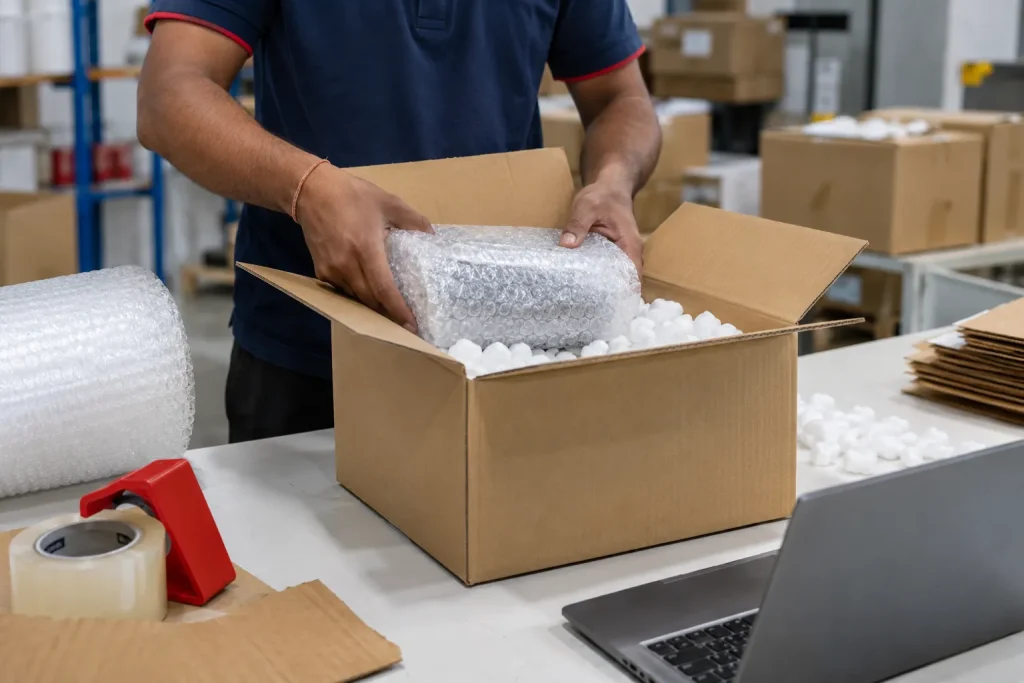
Cushioning works best when it both protects the product and prevents it from shifting inside the carton.
Depending on the item, materials may include:
- Bubble cushioning
- Kraft paper
- Foam
- Other suitable protective materials
The exact method should be chosen for the product rather than copied mechanically from a generic rule.
UPS India recommends appropriate cushioning and filling empty spaces to limit movement.
4. When Should You Double-Box a Shipment?
Double-boxing can be useful for fragile, sharp, valuable or especially vulnerable items.
In a two-box approach, the product is protected inside an inner carton and that carton is then cushioned inside a stronger outer carton.
Double-boxing adds size and weight, so use it when the protection benefit justifies it.
Do not remove necessary protection merely to lower volumetric weight.
FedEx India recommends sturdy, undamaged boxes with all flaps intact. FedEx India Packing Guidance
5. Seal the Parcel Properly
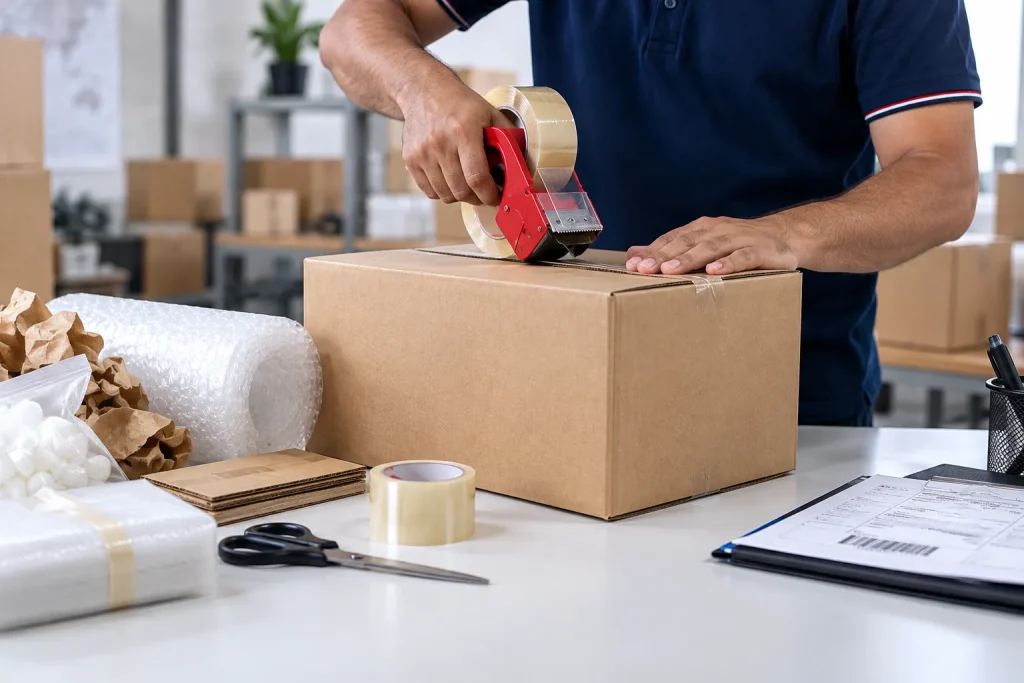
Once the contents are immobilized, close and seal the carton so normal handling does not open the flaps.
Reinforce the main seams and closures with suitable shipping tape.
Avoid relying on string, paper over-wrap or unsuitable household tape as the primary closure.
After sealing, check that:
- The carton remains square.
- The flaps are securely closed.
- No product is pressing against the outer walls.
- Nothing is protruding through the outer carton.
6. Keep Labels and Shipment Information Clear
Shipping information should remain clear and readable throughout the shipment process.
FedEx India advises making sure the air waybill is legible and placing it on top of the package.
Keep the current shipment label:
- Flat
- Readable
- Away from folds or edges where possible
If you are reusing a carton, remove or cover obsolete labels, barcodes and old hazardous-material markings so they do not create confusion during sorting.
7. Pack Documents and Goods Correctly for Courier Customs
India’s Courier Imports and Exports (Electronic Declaration and Processing) Regulations require imported or export goods to be packed separately for documents and goods.
The regulations also require a declaration from the sender or consignor regarding the contents of each package and the total value.
This is one reason accurate packaging and accurate documentation should be prepared together.
The physical parcel, invoice or packing information and customs declaration should describe the shipment consistently.
8. Measure Only After Final Packing
Do not give courier dimensions from the product box before cushioning and final sealing.
Measure the external:
- Length
- Width
- Height
of the finished parcel.
Also record the final packed weight.
How Is Volumetric Weight Calculated?
AICS currently publishes the following volumetric-weight formula in its dedicated guide:
Length × Width × Height in centimetres ÷ 5,000
FedEx India also publishes a 5,000 divisor for centimetre measurements.
Service-specific rules can differ, so the final billing method should always be confirmed for the service being booked.
Example: Why Right-Sizing Can Matter
Suppose an item is safely packed in a 50 × 35 × 25 cm carton.
Using a 5,000 divisor:
50 × 35 × 25 ÷ 5,000 = 8.75 kg
Now suppose the same protected item is placed unnecessarily in a 60 × 40 × 30 cm carton.
60 × 40 × 30 ÷ 5,000 = 14.4 kg
This does not mean you should always choose the smaller box.
It means unnecessary empty volume can affect the quote.
Safety comes first; then remove avoidable space where practical.
9. Packaging Fragile Items for International Courier
Fragile goods need a product-specific protection plan. Glass, ceramics, electronics, artwork and delicate samples do not all fail in the same way.
For fragile items:
- Wrap individual pieces separately where contact could cause damage.
- Use internal dividers or separation where multiple items share a carton.
- Protect corners and vulnerable edges.
- Prevent the item from touching the outer carton where impact risk is high.
- Consider double-boxing when the product and route justify it.
A “Fragile” label can communicate handling information, but it is not a substitute for protective packaging.
10. Common International Courier Packing Mistakes
Avoid these common packaging mistakes:
- Using a weak or damaged carton.
- Leaving large empty spaces so products move inside.
- Using an oversized box without a protection reason.
- Measuring dimensions before final packing.
- Leaving old labels or barcodes visible.
- Allowing fragile items to strike each other.
- Packing restricted or dangerous goods without checking acceptance rules.
- Using vague or inconsistent product descriptions across the parcel and documents.
Export Packaging Checklist Before Pickup
Before handing over an international courier parcel, check the following:
☐ Item is eligible for the selected courier/service.
☐ Outer carton is sturdy, dry and undamaged.
☐ Contents are cushioned and cannot move freely.
☐ Fragile items have product-appropriate protection.
☐ All flaps and seams are securely sealed.
☐ Old labels/barcodes are removed or covered.
☐ Current shipping label/AWB can be placed clearly.
☐ Documents and goods are prepared in line with courier/customs requirements.
☐ Final packed weight and external dimensions are recorded.
☐ Destination, item description, carton count and value are ready for the quote/document process.
Before pickup, make sure your parcel is ready for the selected international courier service from India.
When Professional Packing Support Makes Sense
Professional packing support can be useful when the item is:
- Fragile
- Unusually shaped
- High-value
- Part of a commercial export
- Difficult to right-size safely
It can also help when several products must be consolidated into export-ready cartons.
For fragile, commercial or unusual shipments, review the packaging and shipment details before dispatch. This can help prevent avoidable repacking, quoting errors and processing delays.
Businesses preparing commercial exports can also explore AICS export shipment services for their international shipping requirements.
Frequently Asked Questions (FAQs)
A sturdy, undamaged carton with product-appropriate cushioning and secure sealing is a practical baseline. The exact packaging should match the item’s fragility, weight, shape and handling risks.
Only if it remains structurally strong, dry and undamaged. Remove or cover old labels, barcodes and obsolete markings. For fragile or valuable goods, a fresh strong carton may be the safer choice.
Some fragile, sharp or vulnerable goods benefit from double-boxing, but it is not mandatory for every item. Use it when the added protection is justified.
Measure volumetric weight after the parcel is completely packed and sealed, using the final external dimensions.
It can reduce dimensional weight when unnecessary empty space is removed, but the final price also depends on destination, service, shipment type and carrier rules.
Not every shipment uses the same document set. Commercial/export shipments may require a packing list or other supporting documents depending on the shipment and customs process. Check the applicable requirements.
No. A fragile label can communicate information, but safe delivery still depends on appropriate internal and external packaging.
Conclusion
Export packaging for international courier is a balance between protection, compliance and efficient use of space.
Start with the product’s real risks, use a strong right-sized carton, stop internal movement, seal and label the parcel clearly, and record final dimensions only after packing.
For fragile, commercial or unusual shipments, review the packaging and shipment details before dispatch. That small step can help prevent avoidable repacking, quoting errors and processing delays.
Export Packaging for International Courier is a balance between protection, compliance and efficient use of space.
Get an International Courier Quote
Before pickup, share the item description, destination country/postcode, number of cartons, actual packed weight and final dimensions with AICS Logistics.
If the item is fragile or needs special handling, mention that before the quote so the shipment can be reviewed appropriately.