Introduction
You’ve paid to send a parcel from India to another country. A few days later, the person receiving it gets a message from the courier asking them to pay customs charges before delivery.
Naturally, this raises a question: If the sender has already paid for international shipping, why does the receiver need to pay again?
This situation is common when sending gifts, personal parcels or commercial shipments overseas.
The answer depends on the destination country’s import rules, the shipping terms and the payment arrangements agreed upon before dispatch.
Understanding who pays customs duty on international courier from India can help both senders and receivers avoid unexpected bills and delivery complications.
Quick Answer: Who Pays Customs Duty?
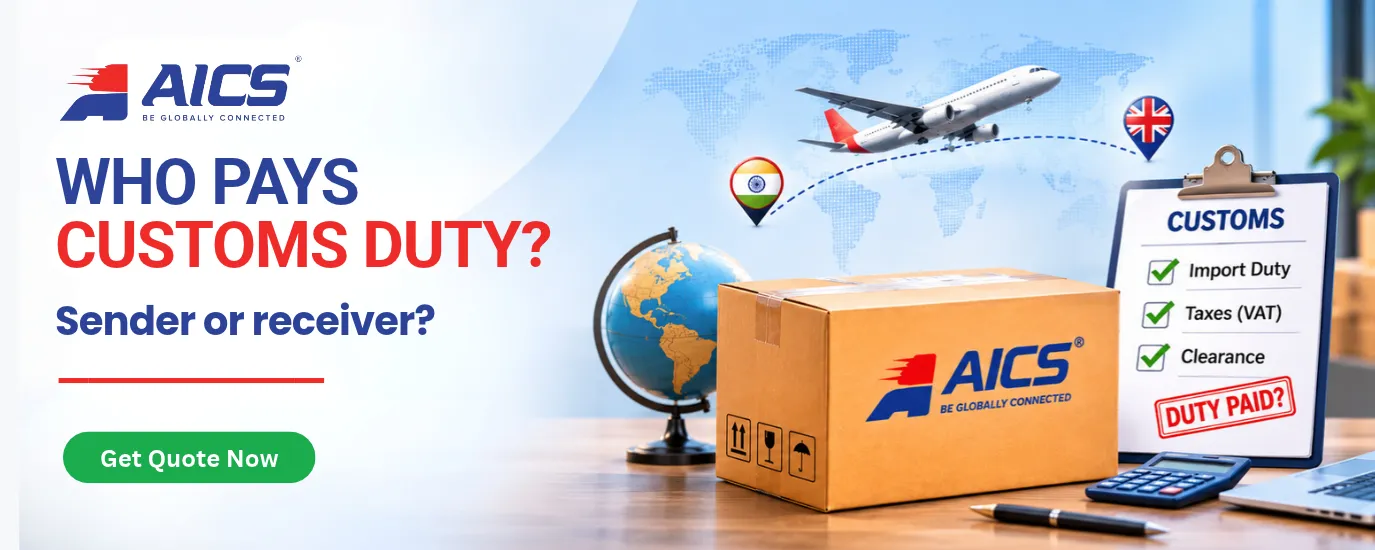
The receiver or importer often pays customs duty and import taxes in the destination country unless an eligible sender-paid arrangement or commercial agreement assigns those costs elsewhere.
Paying international courier charges does not automatically include import duties or taxes.
Before booking, confirm who is legally responsible for importing the goods, who has agreed to cover the charges and whose account the courier will bill.
These are three separate considerations.
What Exactly Are Customs Duty Charges?
When a parcel reaches another country, the receiver may be asked to pay several different charges.
Customs duty is a government levy imposed on imported goods according to the destination country’s rules.
Import VAT or GST is a separate tax that may apply based on the product, shipment value and destination.
Courier clearance or handling fees may be charged for customs processing, advancing import taxes or providing related services.
International shipping charges cover transporting the parcel from India to the destination.
A courier quotation may include transport costs without including destination customs charges.
If you receive an unexpected payment request, ask for an itemised breakdown instead of assuming the entire amount is customs duty.
Three Things That Determine Who Pays Customs Duty
There are three important questions to consider before shipping an international parcel.
1. Who Is Legally Responsible for Importing the Goods?
The importer of record is the party responsible for meeting the destination country’s customs requirements.
Depending on the destination, the importer may need to provide identity details, registration information or additional documents.
Even if another person pays the customs bill, the legally designated importer may still be responsible for the required import formalities.
2. Who Has Agreed to Pay the Charges?
For commercial shipments, the buyer and seller should agree on who will pay import duties and taxes before confirming the order.
For example, an Indian online seller might include international shipping in the product price while leaving import duties payable by the overseas buyer.
For a personal parcel or family gift, the sender and receiver should discuss any possible customs charges before dispatch.
Commercial delivery terms should not automatically be applied to private gifts.
3. Whose Account Will the Courier Bill?
Some courier companies offer arrangements that allow import duties and taxes to be billed to an eligible sender account instead of the receiver.
However, the availability of sender-paid billing depends on the carrier, destination, shipment type and account conditions.
For example, DHL describes Duties and Taxes Paid (DTP) as a carrier billing option that is separate from commercial Incoterms.
The person paying the courier’s invoice is not necessarily the legal importer of the goods.
This distinction is particularly important for international business shipments.
DAP vs DDP: Who Pays Customs Duty in International Shipping?
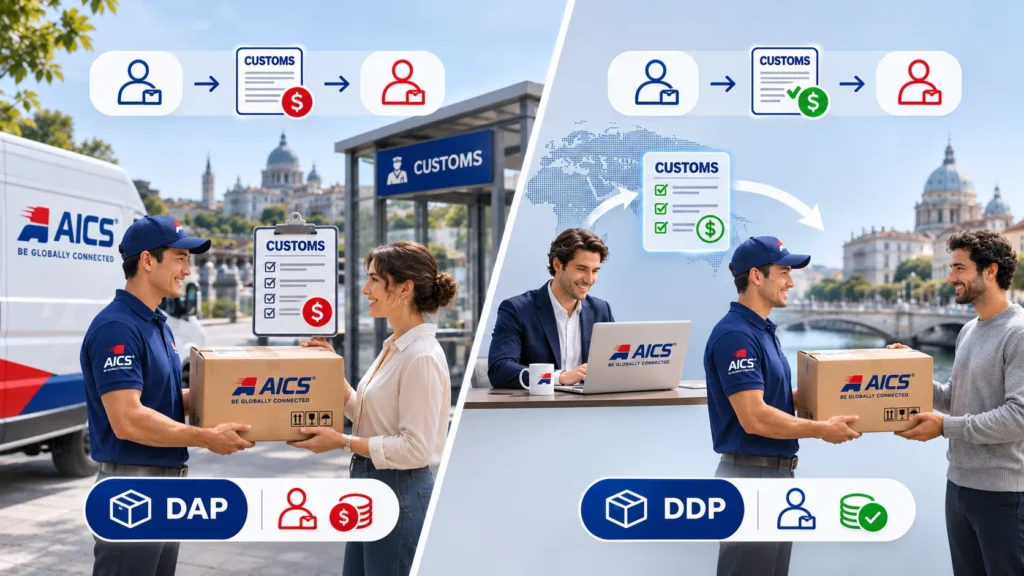
For commercial exports, two commonly used shipping terms are DAP (Delivered at Place) and DDP (Delivered Duty Paid).
These are part of the International Chamber of Commerce’s Incoterms 2020 rules, which define responsibilities between buyers and sellers.
| Responsibility | DAP (Delivered at Place) | DDP (Delivered Duty Paid) |
|---|---|---|
| Transport to the agreed destination | Seller | Seller |
| Import customs clearance | Buyer | Seller |
| Import duties and applicable taxes | Buyer | Seller |
| Import formalities | Buyer | Seller |
| Carrier billing arrangement | Confirm separately | Confirm separately |
What Is DAP Shipping?
Under DAP, the seller arranges transportation to the agreed destination, but the buyer is responsible for import clearance and applicable duties and taxes.
For example, an Indian manufacturer sending products to a customer in Germany may arrange delivery under DAP terms.
The seller handles transportation to the agreed place, while the German buyer manages the import process and pays the applicable import charges.
What Is DDP Shipping?
Under DDP, the seller assumes responsibility for delivering the goods to the agreed destination, including the applicable import clearance obligations, duties and taxes.
For example, an Indian e-commerce seller may wish to offer overseas customers a delivered price that includes import charges.
However, the seller must first verify whether it can legally fulfil the destination country’s import requirements.
DDP may not be practical or available for every destination or shipment.
Important: DDP is a commercial delivery term, while sender-paid duty billing is a payment arrangement offered by a courier. Paying the duty bill from India does not automatically make a shipment DDP.
For more information, refer to the International Chamber of Commerce’s Incoterms guidance.
Can the Sender Pay Customs Duty from India?
Yes, it may be possible for the sender to pay destination customs duty from India, depending on the available courier service and billing arrangement.
Some international courier providers allow duties and taxes to be billed to an eligible shipper account.
Before booking, ask whether this option is supported for the selected country, commodity and shipment type.
If sender-paid billing is unavailable, the receiver may need to pay the charges locally. The sender can then separately agree to reimburse the receiver.
Do not promise that the recipient will have nothing to pay unless the booking terms clearly support that arrangement.
Example: Sending a Gift from India to the UK
Suppose a parent in Ahmedabad sends clothing to a family member living in London.
The sender pays the international courier charges in India.
However, when the parcel reaches the UK, import charges may apply depending on the genuine gift status, declared value and applicable customs rules.
If a charge is assessed and no sender-paid arrangement was made, the delivery company may contact the receiver for payment before completing delivery.
The UK government’s guidance on goods sent from abroad explains how import charges can apply.
A genuine gift is not automatically exempt from customs duties or taxes.
For destination-specific information, read the AICS guide on UK customs charges on parcels from India.
Example: An Indian Online Seller Shipping Overseas
Consider a Surat-based e-commerce seller receiving an order from an international customer.
The seller wants to offer a convenient delivered price that includes shipping and potentially import charges.
Before promising an all-inclusive delivery, the business should confirm whether it can meet the destination’s import obligations and whether the courier supports the required billing arrangement.
The seller should also understand whether the duty amount is an estimate and who would pay if the customs authority reassesses the charges.
If the buyer is responsible for import duties, that information should be clearly communicated before checkout.
Clear delivery terms help businesses reduce unexpected customer payment requests and disputes.
Does Marking a Parcel as a Gift Avoid Customs Duty?
No. Writing “gift” on a parcel does not automatically make it duty-free.
Gift exemptions depend on the destination country’s regulations, the actual nature of the shipment and the declared value.
A commercial order should never be described as a gift to avoid customs charges.
Always provide an accurate product description, genuine value, quantity and shipment purpose.
Even legitimate gifts may attract taxes or duties depending on the destination.
What Happens If the Receiver Refuses to Pay Customs Duty?
If the receiver refuses or is unable to pay the required customs charges, the courier may hold the parcel while requesting payment or additional instructions.
Depending on local regulations and the courier’s conditions, the shipment may eventually be returned or handled through another applicable procedure.
The sender may also face storage, return or other charges.
If your parcel is already being held:
Contact the courier using the airway bill (AWB) or tracking number.
Request a breakdown of the charges.
Ask about the payment deadline and available options.
Check whether an alternative billing arrangement is possible.
Request written details of potential return or storage costs.
If the shipment is delayed, ask whether payment is the only outstanding issue.
Settling customs duty does not guarantee immediate release if documents, permits or customs inspections are still pending.
For related guidance, read AICS’s articles on international courier customs clearance delays and returned international parcels.
How to Check a Customs Payment Request Safely
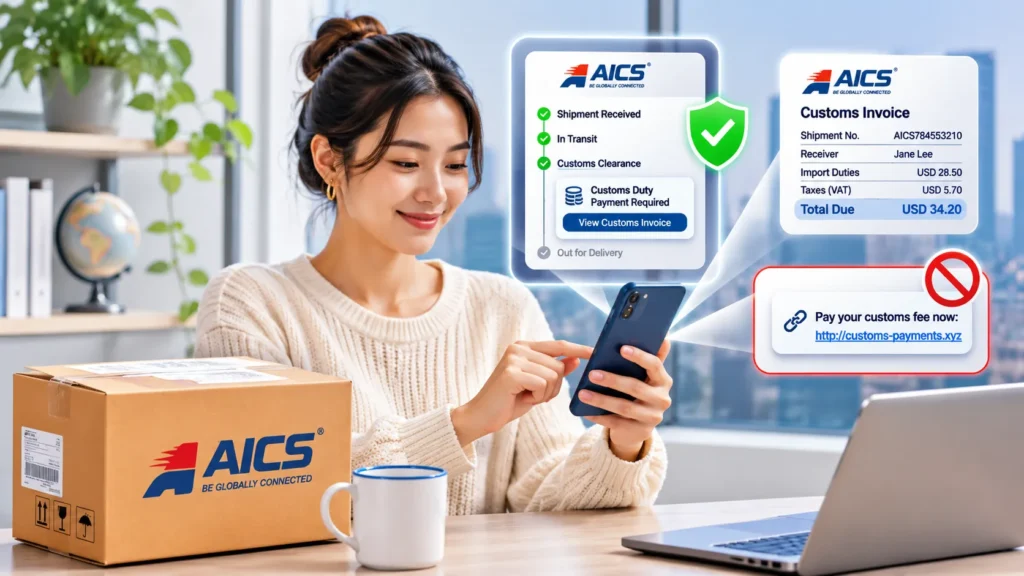
A customs payment request may arrive by SMS, email or a courier notification.
Before paying, verify that the request is genuine.
Open the courier company’s official tracking website independently and enter your AWB number.
Check that the shipment details match your parcel, and request an itemised breakdown of duty, import taxes and service fees.
If the amount appears inconsistent with the original booking, ask the courier to review the billing arrangement and explain any available assessment dispute process.
Avoid sending money to an unknown personal account or sharing identification documents through suspicious payment links.
Keep the invoice and payment receipt for future reference.
Six Questions to Ask Before Booking an International Courier
Before sending an international parcel from India, ask your courier provider these six questions:
Does the quotation cover transportation only, or does it include destination customs duty and taxes?
Who will be the importer, and who will receive the courier’s customs payment request?
Is sender-paid customs duty billing available for the destination and product?
Are estimated duties subject to reassessment, and who will pay any difference?
Are customs clearance, advancement, storage or return charges excluded from the quote?
What happens if the receiver refuses to pay or cannot complete customs clearance?
Getting clear answers before dispatch can help both the sender and receiver understand the possible costs.
How AICS Can Help with Your International Courier Shipment
When sending parcels abroad, understanding the complete shipping arrangement is just as important as knowing the courier price.
Arihant International Courier Services (AICS) helps individuals, families and businesses arrange international courier shipments from India.
AICS provides courier coordination, packaging assistance, shipment tracking and export documentation support.
Before requesting a quote, share your destination country, parcel contents, genuine declared value, packed weight and dimensions.
Also mention whether you would prefer the sender or receiver to pay any applicable destination customs charges.
The AICS team can review available shipping options and help clarify which charges are included in the quotation and which may be collected separately.
Final customs assessment, carrier billing options and importer requirements depend on the destination, commodity and selected service.
Explore our international courier service or request a courier quotation before booking.
Frequently Asked Questions (FAQs)
No. Courier transportation charges and destination customs duty are separate unless the booking explicitly includes both.
Some courier services allow eligible sender-paid billing. Confirm the destination, carrier, account eligibility and importer requirements before dispatch.
No. DDP is a commercial delivery term that assigns import clearance and duty responsibilities to the seller. Sender-paid duty is a courier billing arrangement.
The amount is determined under the destination country's customs rules and assessment. The courier may collect or advance these charges according to its service terms.
No. Gift relief depends on the destination country's rules and whether the parcel meets the relevant conditions. Genuine gifts can still attract import taxes or duties.
It depends on the destination's clearance requirements and the courier's payment arrangements. Confirm the applicable process with the selected courier.
Final Thoughts
When sending an international parcel from India, deciding who will pay customs duty before dispatch is better than dealing with an unexpected payment request after arrival.
The receiver or importer often pays destination import charges, but commercial agreements and eligible sender-paid billing arrangements can change who bears the cost.
Before booking, confirm the importer, agreed payment responsibility and courier billing instructions.
Most importantly, remember that paying international courier charges does not automatically mean customs duty is included.
Planning to Send an International Parcel from India?
Whether you are sending gifts to family abroad or commercial goods to overseas customers, AICS can help you review available international courier options.
Share your destination, parcel contents, declared value, packed dimensions and preferred customs duty payer.
Get an International Courier Quote & Confirm Duty Billing
Call AICS: +91 94260 52754
Website: www.aics.in
Regulatory note: Customs duties, import taxes and carrier billing arrangements vary by destination, commodity and shipment terms. Confirm the applicable requirements with the selected courier and relevant customs authority before dispatch.