Introduction
Restricted items in international courier India are one of the most important factors to check before sending any parcel abroad. Many international shipments get delayed, rejected, returned, or held by customs because customers unknowingly pack prohibited or restricted products without proper approval or documentation.
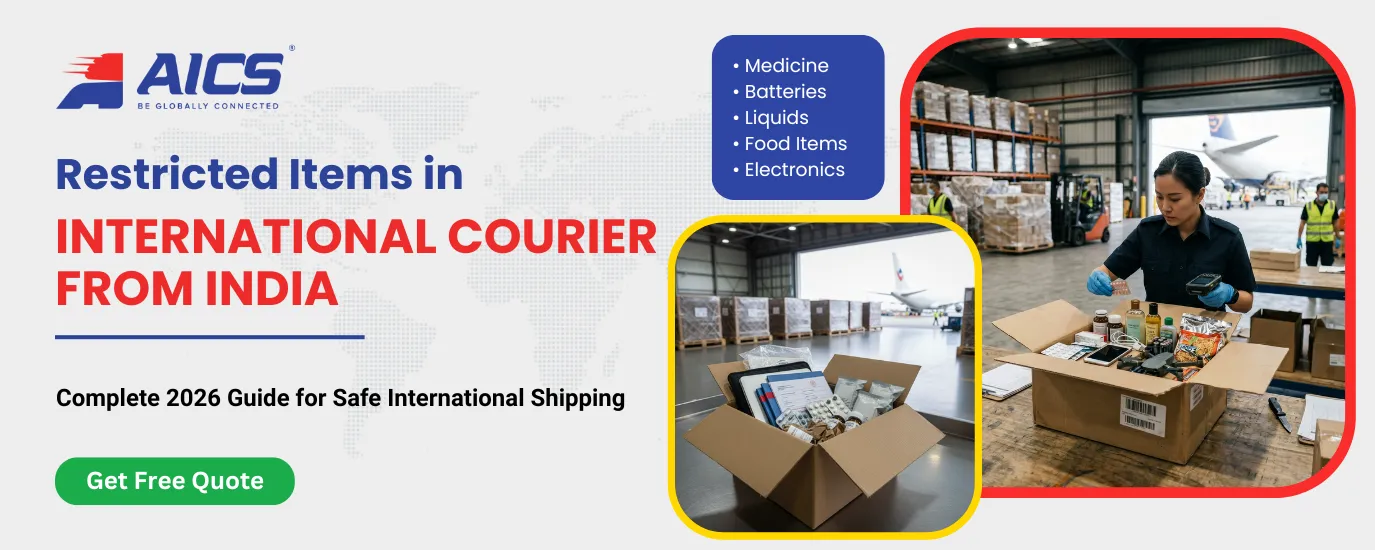
Different countries have different customs regulations, airline safety rules, and import restrictions. Items such as medicines, batteries, liquids, food products, electronics, perfumes, and chemicals may require special packaging, declaration, or courier approval before international shipping from India.
Understanding restricted items in international courier India helps customers avoid customs delays, shipment rejection, extra charges, and international shipping issues. Whether you are sending personal parcels, student luggage, commercial shipments, gifts, documents, or export goods, it is important to verify item eligibility before dispatch.
AICS Logistics provides international courier support from India with documentation guidance, pickup assistance, shipment tracking, and reliable global delivery services across 220+ countries.
Quick Answer: What Items Are Restricted in International Courier?
Restricted items international courier usually include liquids, perfumes, batteries, power banks, medicines without prescription, food items, alcohol, tobacco, cash, jewellery, sharp objects, chemicals, flammable products, and hazardous materials.
Some items are completely prohibited, while others may be accepted only with proper documents, packaging, declaration, courier approval, airline acceptance, and destination-country customs clearance.
Final acceptance always depends on courier company policy, airline safety regulations, customs rules, and destination-country laws.
Restricted vs Prohibited vs Conditionally Allowed Items
Before sending any international parcel, it is important to understand the difference between these three categories.
| Category | Meaning | Examples |
|---|---|---|
| Prohibited Items | Items that generally cannot be shipped through regular courier | Cash, narcotics, explosives, firearms |
| Restricted Items | Items that may need approval, special packaging, or extra documents | Medicines, batteries, liquids, chemicals |
| Conditionally Allowed Items | Items that may be accepted only when documents and rules are properly followed | Prescription medicines, packaged food, electronics |
This difference matters because sending a restricted item without approval can lead to customs delay, return, confiscation, or rejection.
Why International Courier Restrictions Exist
International courier restrictions exist mainly for safety, compliance, and customs control.
Courier restrictions help with:
• Airline and cargo safety
• Fire and hazardous material prevention
• Customs and import compliance
• Country-specific legal rules
• Prevention of illegal shipments
• Protection of parcels during transit
• Correct declaration of personal and commercial goods
Even if an item is allowed in India, the destination country may still restrict or prohibit it. So checking item eligibility before dispatch is always important.
Understanding restricted items international courier India guidelines helps customers avoid customs delays, shipment rejection, prohibited shipping issues, and international courier restrictions.
Common restricted products international courier
Below are the most common item categories that customers should check before booking an international courier.
1. Liquids and Semi-Liquids
Liquids are one of the most commonly restricted categories in international courier because they can leak, damage other parcels, or violate air cargo safety rules.
Examples include:
• Oils
• Perfumes
• Cosmetic liquids
• Syrups
• Paints
• Chemical solutions
• Liquid food items
• Cleaning liquids
• Lotions and creams
Some courier companies may allow limited quantities under special packaging and declaration conditions. However, many liquid items are not accepted for regular international air courier.
Best advice: Do not pack liquid items without checking with the courier team first.
2. Batteries, Power Banks, and Lithium Battery Products
Lithium batteries are considered high-risk in air transport because they can overheat or catch fire if damaged, defective, or packed incorrectly.
Commonly restricted battery items include:
• Loose lithium batteries
• Power banks
• Battery packs
• Damaged batteries
• Electronic devices with high-capacity batteries
• Smart luggage batteries
• Rechargeable battery products
For courier shipping, battery acceptance depends on product type, battery capacity, courier network, airline approval, packaging, and destination-country rules.
3. Medicines Without Proper Documents
Medicines may be accepted in many genuine personal-use cases, but documentation is very important.
Medicines usually require:
• Doctor prescription
• Medicine invoice
• Receiver details
• Personal-use declaration
• Medicine list
• Destination-country compliance
If medicines are sent without prescription, invoice, or proper declaration, customs may hold, reject, or return the shipment.
Internal Link Suggestion:
Can You Send Medicines Abroad from India?
4. Food Items and Perishable Products
Food items are one of the most confusing categories in international courier. Some dry and packaged food items may be accepted, but many countries have strict food safety, agriculture, and biosecurity rules.
Commonly restricted food items include:
• Homemade food
• Fresh fruits
• Vegetables
• Dairy products
• Meat products
• Frozen food
• Perishable items
• Open or unpacked food
• Food requiring refrigeration
Food items that may sometimes be accepted:
• Sealed dry snacks
• Packaged spices
• Branded packaged food
• Dry grocery items
• Properly labelled non-perishable items
Final approval depends on destination-country rules, courier policy, packaging, and declaration.
5. Alcohol and Tobacco Products
Alcohol, cigarettes, tobacco products, vaping items, and nicotine products are heavily regulated internationally.
These items are generally restricted or not accepted by many courier companies because of customs laws, age restrictions, duties, taxes, and import controls.
Examples include:
• Alcohol bottles
• Cigarettes
• Tobacco packets
• Cigars
• Vape products
• Nicotine products
Best advice: Avoid sending alcohol or tobacco products through regular international courier.
6. Cash, Currency, Jewellery, and Valuable Items
Courier companies generally do not accept high-value valuables because of security, insurance, and legal risks.
Commonly prohibited or restricted items include:
• Cash
• Currency notes
• Gold
• Silver
• Jewellery
• Precious stones
• Bullion
• High-value collectibles
• Negotiable instruments
7. Flammable and Hazardous Materials
Hazardous goods are strictly controlled in international courier and air cargo because they can create risk to health, safety, aircraft, parcels, and property.
Examples include:
• Fireworks
• Fuel products
• Gas cylinders
• Aerosol cans
• Paint thinners
• Chemicals
• Explosive materials
• Flammable liquids
• Corrosive substances
• Toxic substances
These items should not be sent through regular courier without proper dangerous goods approval.
8. Sharp Objects, Weapons, and Ammunition
Sharp objects and weapons are usually prohibited or highly restricted in international courier.
Examples include:
• Knives
• Firearms
• Ammunition
• Sharp tools
• Swords or weapon-like objects
• Explosive devices
Most regular international courier services do not accept these items.
9. Live Animals, Plants, Seeds, and Organic Material
Many countries have strict biosecurity and agriculture rules. These items may carry pests, diseases, or biological risks.
Restricted items may include:
• Live animals
• Plants
• Seeds
• Soil
• Biological samples
• Organic materials
• Animal products
• Plant-based raw materials
Australia, Canada, the USA, and many European countries can be very strict with agricultural and biological imports.
10. Counterfeit, Illegal, or Copyright-Infringing Goods
Illegal or counterfeit goods should never be shipped internationally.
Examples include:
• Fake branded products
• Pirated goods
• Illegal drugs
• Narcotics
• Unauthorized replicas
• Items banned by law
Conditionally Allowed Items in International Courier
Some items are not fully banned but need special checking before shipping.
Medicines
Medicines may be accepted with prescription, invoice, declaration, and destination-country approval.
Internal Link:
Send Medicines Abroad from India
Electronics
Electronics may be accepted depending on battery type, product condition, packaging, and destination rules.
Examples include:
• Mobile phones
• Laptops
• Tablets
• Cameras
• Electronic accessories
Battery-containing electronics need extra checking before shipping.
Food Products
Packaged, sealed, dry food items may be accepted in some countries. However, food rules vary heavily by destination.
Cosmetics
Some cosmetics may be restricted if they contain liquid, alcohol, aerosol, or chemical ingredients.
Commercial Goods
Commercial shipments may need GST invoice, IEC, product invoice, packing list, export documents, and customs declaration.
Country-Specific Courier Restrictions
International courier restrictions change from country to country.
USA
The USA has strict checks for medicines, food items, supplements, biological items, chemicals, and commercial goods.
Internal Link:
Courier to USA from India
Canada
Canada may restrict certain food items, agriculture products, organic materials, medicines, and commercial goods.
Australia
Australia is known for strict biosecurity rules. Seeds, plant material, soil-contaminated goods, certain food items, and organic products may face strict inspection.
UK
The UK may restrict tobacco products, certain medicines, sharp objects, high-value goods, and some food categories.
UAE / Dubai
The UAE has strict rules for medicines, religious material, food products, chemicals, and regulated goods.
Common Reasons International Shipments Get Delayed or Rejected
International shipments may get delayed, returned, rejected, or confiscated due to:
- Missing documents
- Wrong product declaration
- Restricted or prohibited items
- Improper packaging
- Incomplete receiver address
- Incorrect phone number
- Customs duty issue
- Undeclared commercial value
- No prescription for medicines
- Battery or hazardous item issue
- Destination-country import restriction
Understanding restricted items international courier India rules helps customers avoid customs delays, shipment rejection, prohibited shipping issues, and international courier restrictions before dispatching parcels internationally.
Documents Required forrestricted products international courier
Depending on the shipment type, these documents may be required:
- KYC ID proof
- Commercial invoice
- Packing list
- Declaration form
- Prescription for medicines
- Product invoice
- Receiver details
- Import permit, if required
- Export permit, if required
- MSDS for certain chemical or regulated products
AICS’s FAQ page also says common documents include shipping invoice, ID proof, receiver details, and customs declaration forms.
Before booking any shipment, it is recommended to verify restricted items international courier India policies, destination-country regulations, and courier acceptance rules.
Required Documents Details:
Documents Required for International Courier from India
Before You Pack: Quick Safety Checklist
Before booking an international courier from India, check these points:
- Is the item allowed in the destination country?
- Is the item restricted by the courier company?
- Does the item need prescription, invoice, or declaration?
- Is the item liquid, battery-based, flammable, or fragile?
- Is the receiver address complete and accurate?
- Is the product for personal use or commercial use?
- Are all items listed correctly in the packing list?
- Is the package strong enough for international transit?
This simple checklist can prevent most customs and courier issues.
Before booking any parcel, customers should verify restricted items international courier India policies for medicines, batteries, liquids, food items, and electronics.
Tips for Smooth International Courier Shipping
Before Shipping
• Verify item eligibility
• Avoid prohibited products
• Declare items honestly
• Keep invoices ready
• Use strong packaging
• Mention accurate item value
• Check destination-country rules
• Share complete receiver details
Before shipping restricted or sensitive products internationally, customers should review the DHL Shipping Restrictions Guidelines for updated courier policies and prohibited item categories.
During Shipping
• Track shipment regularly
• Keep documents accessible
• Stay available for customs queries
• Respond quickly if courier team asks for clarification
After Shipping
• Share tracking number with receiver
• Monitor customs updates
• Keep invoice and documents saved until delivery
Why Choose AICS Logistics for International Courier?
AICS Logistics provides international courier support for personal parcels, documents, student luggage, medicines, food items, export shipments, import shipments, and commercial cargo.
Key advantages:
- International delivery support to 220+ countries
- Doorstep pickup assistance
- Packing guidance
- Documentation support
- Real-time tracking
- Courier and cargo expertise
- Support for personal and commercial shipments
- Customs-related guidance
- Trusted international courier process
AICS is especially helpful when customers are unsure whether their item can be shipped or what documents are required.
Frequently Asked Questions (FAQs)
Common prohibited items include cash, currency, explosives, flammable products, narcotics, firearms, ammunition, hazardous chemicals, jewellery, precious metals, and restricted valuables.
Some packaged and dry food items may be accepted, but homemade, perishable, dairy, meat, fresh fruits, and vegetables are usually restricted. Final approval depends on destination-country rules and courier policy.
Yes, medicines may be shipped in many genuine personal-use cases, but they usually require doctor prescription, invoice, declaration, and destination-country compliance.
Power banks and lithium batteries are restricted by many courier and airline networks because of fire risk. They should not be shipped without checking courier approval.
Perfumes are generally restricted because they often contain alcohol and are treated as flammable or liquid items. Acceptance depends on courier and destination rules.
The shipment may be delayed, returned, confiscated, rejected, destroyed, or held by customs. Additional charges or penalties may also apply depending on the case.
Declare items correctly, avoid prohibited products, keep invoices ready, provide a proper packing list, use correct documents, and check destination-country rules before shipping.
Conclusion
Understanding restricted items in international courier from India is essential before sending any parcel abroad. Many items that look normal, such as food products, medicines, cosmetics, batteries, liquids, or electronics, may still require special documents, packaging, approval, or customs clearance.
The safest approach is simple: check item eligibility before packing, declare everything correctly, keep documents ready, and work with an experienced international courier partner.
AICS Logistics helps customers ship documents, parcels, medicines, food items, student luggage, and commercial goods with proper guidance, pickup support, tracking, and international delivery assistance.